Australia Subclass 491 to PR Pathway Guide 202
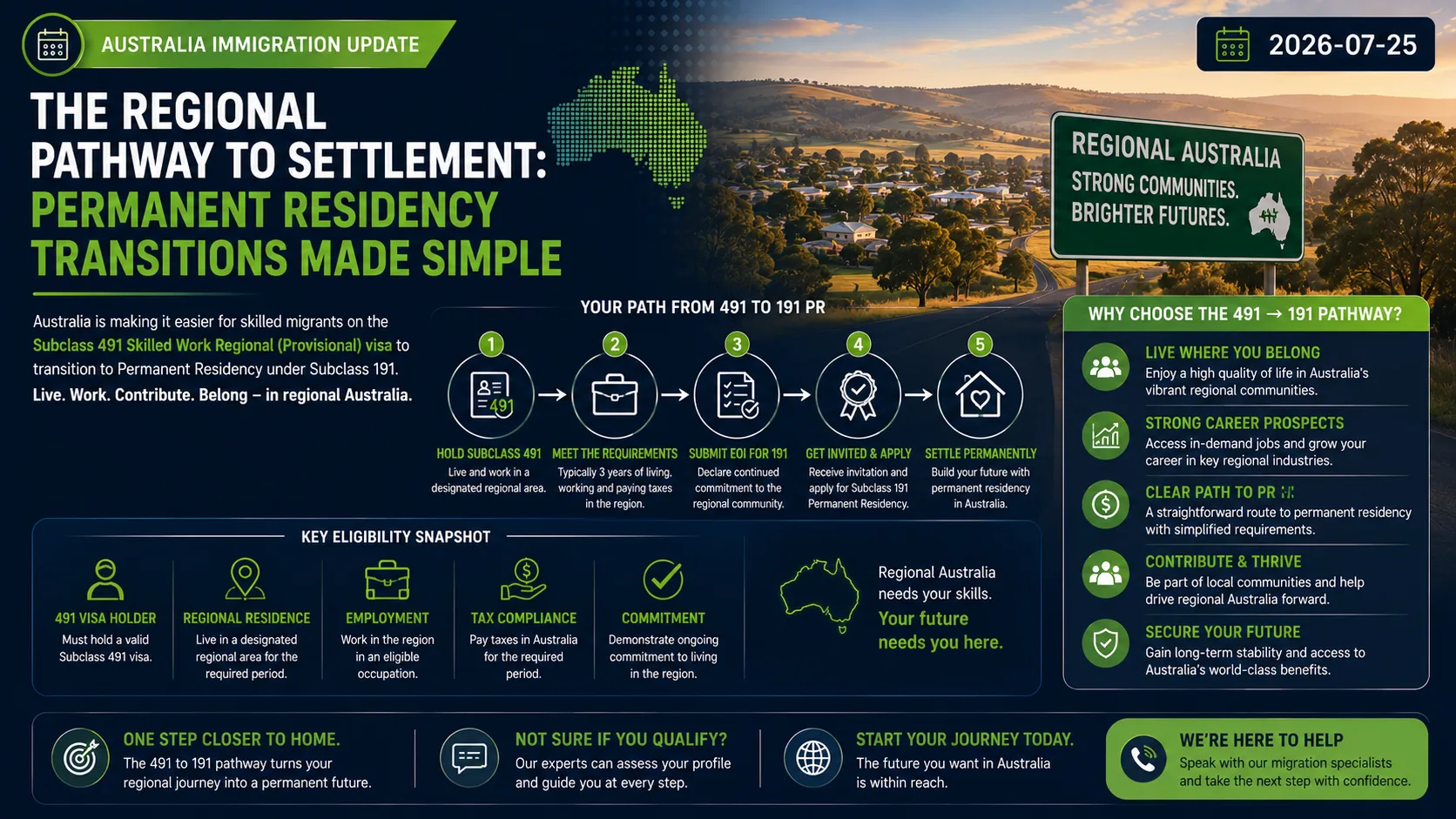
The Australian federal government has simplified the legal transition path from the provisional Subclass 491 visa to full permanent residency under the Subclass 191 framework.
Quick answer: Does a subclass 491 visa automatically become permanent residence?
No. Subclass 491 is provisional. Eligible holders may apply separately for subclass 191 after meeting the applicable three-year and visa-compliance requirements. Official source: https://immi.homeaffairs.gov.au/visas/getting-a-visa/visa-listing/permanent-residence-skilled-regional-191
Australia’s Skilled Work Regional (Provisional) visa, subclass 491, is designed for skilled people prepared to live, work and study in designated regional areas. It offers a five-year provisional stay and, for eligible holders, a later opportunity to apply for permanent residence through subclass 191.
The Australia subclass 491 to PR pathway is not an automatic conversion after three years. Applicants must meet the conditions of their regional visa, keep the necessary tax and residence records, and qualify separately for the Permanent Residence (Skilled Regional) visa.
What is the subclass 491 visa?
The subclass 491 visa is a points-tested provisional visa for eligible skilled workers nominated by a state or territory government or sponsored by an eligible family member. Applicants need an occupation on the relevant skilled occupation list, a suitable skills assessment, an invitation and the required points.
Successful primary applicants can stay in Australia for five years and are generally required to live, work and study in a designated regional area. The visa also permits travel to and from Australia during its validity, subject to its conditions.
Official subclass 491 requirements: https://immi.homeaffairs.gov.au/Visa-subsite/Pages/work/491-skilled-work-regional.aspx
What counts as regional Australia?
Regional Australia is defined by the Australian Government’s designated regional area rules, not by whether a location looks rural. Some sizeable cities and surrounding areas are included, while Sydney, Melbourne and Brisbane are excluded from the designated regional classification.
Applicants should check the official postcode list before accepting a position or signing a lease. A workplace or residential address outside the eligible area can create compliance issues.
How does the subclass 491 points test work?
The points-tested pathway requires a minimum score of 65 points, but reaching that threshold does not guarantee an invitation. Age, English ability, skilled employment, qualifications and other recognised factors contribute to the score.
An eligible state or territory nomination or family sponsorship for subclass 491 provides 15 points. The points claimed in SkillSelect must be supported by evidence when the visa application is assessed.
What are the two sponsorship routes?
State or territory nomination
A state or territory can nominate applicants who satisfy its own criteria in addition to federal visa requirements. Each jurisdiction may prioritise different occupations, experience or settlement connections. Programme availability and nomination allocations can change.
Eligible family sponsorship
Some applicants can use sponsorship by a qualifying relative who lives in a designated regional area and meets the relationship and status requirements. A family sponsor does not replace the skills assessment, points test or other federal eligibility conditions.
When can subclass 491 holders apply for PR?
The principal permanent residence pathway is the subclass 191 Regional Provisional stream. Applicants must have held an eligible subclass 491 or subclass 494 visa for at least three years and complied with its conditions. The three-year period is an eligibility requirement, not a promise that permanent residence will be approved immediately.
The subclass 191 application is separate. The Department assesses the applicant’s immigration history, visa compliance, identity, health, character and other requirements.
Official subclass 191 rules: https://immi.homeaffairs.gov.au/Visa-subsite/Pages/work/191-regional-provisional-stream.aspx
Is there a minimum salary for subclass 191?
The detailed Department of Home Affairs guidance for the subclass 191 Regional Provisional stream states that there is no minimum income requirement. Applicants must nevertheless provide Australian Taxation Office notices of assessment for three income years out of the five years of their eligible visa.
Some older guidance refers to an annual taxable income threshold. Applicants should follow the current detailed subclass 191 requirements rather than relying on those older figures. They should also resolve any Australian Taxation Office debt or provide evidence of an approved payment plan where relevant.
Which documents help demonstrate regional compliance?
Evidence may include residential leases, utility bills, employment records, payslips and other documents showing where the applicant lived and worked. Study records may be relevant when demonstrating compliance with regional study conditions.
Keep records throughout the provisional visa period rather than trying to reconstruct them years later. Address changes and periods spent outside Australia may need careful explanation against the actual visa conditions.
Can subclass 491 holders move to Sydney or Melbourne?
While holding subclass 491, visa holders must comply with the designated regional area conditions. Moving to a non-designated location to live, work or study can breach those conditions and affect a later subclass 191 application.
After a subclass 191 visa is granted, the holder has permanent residence and can generally live and work anywhere in Australia. The change in rights occurs on grant of the permanent visa, not simply after three years have elapsed.
Can you switch to another permanent visa before three years?
Subclass 491 holders face restrictions on applying for or being granted certain other permanent visas before they have held subclass 491 for three years. These restrictions make it important to understand the regional pathway before accepting nomination or family sponsorship.
The exact restrictions are set out on the official subclass 491 visa page. Applicants considering a different visa route should obtain advice appropriate to their circumstances rather than assuming every permanent visa remains immediately available.
How does subclass 491 differ from subclass 190?
Subclass 190 is a permanent skilled nominated visa requiring state or territory nomination. Subclass 491 is provisional, can be based on state nomination or eligible family sponsorship, and involves regional conditions and a later subclass 191 application for permanent residence.
The two visas have different points benefits and eligibility criteria. An applicant’s preferred city, occupation, points score and nomination opportunities may affect which pathway is realistic.
Common mistakes on the 491 to 191 pathway
- Treating three years on subclass 491 as automatic permanent residence.
- Moving outside a designated regional area without understanding visa conditions.
- Relying on outdated minimum-income figures for subclass 191.
- Failing to retain ATO notices of assessment for the required income years.
- Assuming any relative in Australia can provide qualifying family sponsorship.
- Claiming points or regional residence that cannot be substantiated.
- Assuming subclass 491 holders can freely switch to any permanent visa before three years.
Frequently asked questions
How long is a subclass 491 visa valid?
The provisional subclass 491 visa generally permits a stay of five years from the date of grant.
Can I apply for subclass 191 after three years?
Potentially, if you have held an eligible visa for at least three years and satisfy the subclass 191 requirements, including compliance and ATO evidence.
Is a fixed income threshold required for subclass 191?
The Department’s detailed current Regional Provisional stream guidance says there is no minimum income requirement, but ATO notices of assessment for three income years are required.
Can I live anywhere in Australia after receiving subclass 191?
Yes. Subclass 191 grants permanent residence and generally permits living and working anywhere in Australia.
How Zevantaa Careers can help
Zevantaa Careers supports skilled professionals in understanding Australian visa pathways, reviewing documentation readiness and identifying questions about points, nomination and regional conditions before proceeding. Applicants should assess the actual regional residence commitment alongside their long-term career plans.
Explore Zevantaa’s Australia visa guidance: https://zevantaacareers.com/visas/australia-immigration/temporary/
Official references
Department of Home Affairs — Skilled Work Regional visa (491): https://immi.homeaffairs.gov.au/Visa-subsite/Pages/work/491-skilled-work-regional.aspx
Department of Home Affairs — Permanent Residence (Skilled Regional) visa (191): https://immi.homeaffairs.gov.au/Visa-subsite/Pages/work/191-regional-provisional-stream.aspx
Department of Home Affairs — Regional work visas: https://immi.homeaffairs.gov.au/work-in-australia/Pages/Regional-migration/regional-visas.aspx