Skills in Demand Visa Subclass 482: Core Skills
Australia’s new Core Skills Pathway streamlines the Subclass 482 visa by simplifying employer sponsorship and creating a clearer route to permanent residency for skilled professionals in high-demand occupations.
Quick answer: Can I apply for Australia’s Core Skills visa without an employer?
No. The Skills in Demand subclass 482 Core Skills stream requires an eligible sponsoring employer and nomination. An occupation on the Core Skills Occupation List alone does not grant a visa. Official source: https://immi.homeaffairs.gov.au/visas/getting-a-visa/visa-listing/skills-in-demand-visa-subclass-482
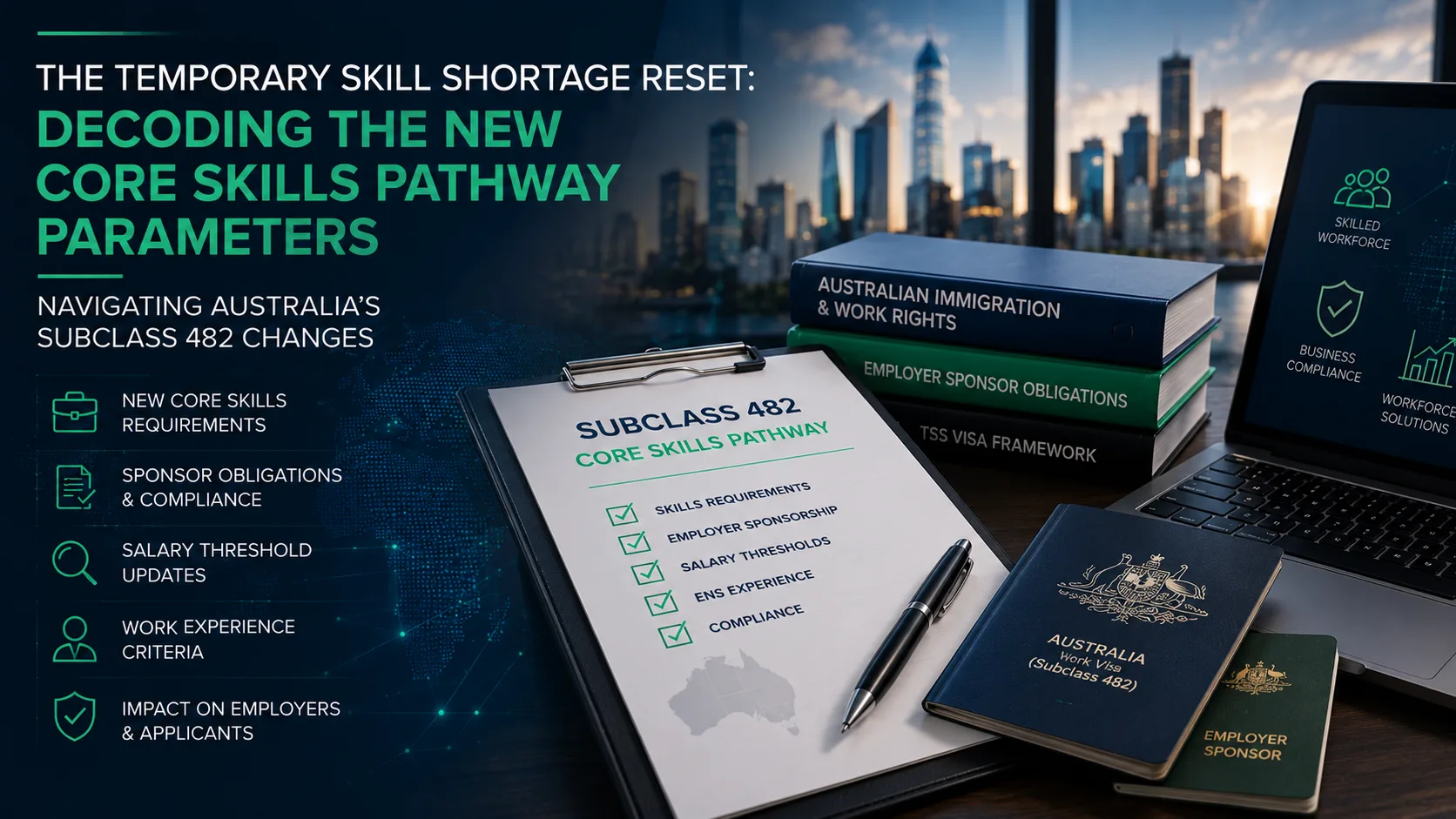
Australia replaced the Temporary Skill Shortage (TSS) visa with the Skills in Demand visa on 7 December 2024. For professionals considering employer-sponsored work in Australia, the change matters because advice written for the old TSS programme may no longer reflect the rules for a new application.
The Skills in Demand visa subclass 482 has several streams. This guide focuses on Core Skills: who can qualify, what an Australian employer must do, and where applicants commonly run into difficulty. It is an employer-sponsored visa, not permission to arrive in Australia and search for work without a nomination.
What changed when the TSS visa was replaced?
The new Skills in Demand framework took effect on 7 December 2024. Applications submitted before the change may be covered by transitional arrangements. New applicants should check the rules for the stream under which they intend to apply rather than relying on earlier TSS guidance.
For Core Skills, the nominated occupation must appear on the Core Skills Occupation List (CSOL). That list is an eligibility tool, not a register of available jobs. An occupation being listed does not mean an employer has a vacancy or that sponsorship will be offered.
Who is eligible for the Core Skills stream?
The Skills in Demand visa subclass 482 requires an eligible employer nomination and a suitable applicant. The Department of Home Affairs identifies several important conditions:
- An approved sponsor must nominate an eligible position and occupation on the CSOL.
- The applicant must have the skills and qualifications needed for the nominated work.
- At least one year of relevant work experience in the occupation or a related field is generally required, subject to the detailed rules.
- The applicant must meet English-language requirements unless an exemption applies.
- A skills assessment, registration or licence may be necessary for some occupations.
- The nominated salary must meet both the applicable income threshold and market-salary requirements.
- Health, character and other visa conditions must also be satisfied.
These requirements work together. A strong CV does not replace a valid nomination, and an employer’s offer does not by itself guarantee a visa.
How should applicants check their occupation?
Occupation matching deserves more attention than it often receives. An employer may use a broad title such as operations manager or software specialist, while immigration assessment depends on the duties and occupation classification that apply to the nominated position.
Applicants should compare their actual responsibilities, qualifications and employment evidence with the nominated occupation. Employers should ensure the role is genuine and accurately described. Choosing a code simply because its title sounds close can create problems later.
What is the Core Skills salary threshold in 2026?
For nominations lodged from 1 July 2026 through 30 June 2027, the Core Skills Income Threshold is AUD 79,423 per year. This is a dated threshold, not a permanent figure; it is indexed and should be checked again before lodging a nomination.
The threshold is only one part of the salary test. Employers must also meet the applicable Annual Market Salary Rate (AMSR). If the market rate for a comparable Australian worker is higher than the minimum threshold, the higher market rate may be relevant. The Department explains how salary and non-monetary benefits are treated in its official guidance.
Official salary guidance: https://immi.homeaffairs.gov.au/visas/employing-and-sponsoring-someone/sponsoring-workers/nominating-a-position/salary-requirements
English, experience and supporting documents
Most primary applicants need evidence of English proficiency unless they qualify for an exemption. Accepted tests, scores and validity rules can change, so applicants should check the current Department of Home Affairs guidance before paying for a test.
Work experience also needs to be evidenced, not merely stated. Employment references should describe real duties and dates. Contracts, payslips and other records may help substantiate the history claimed. Experience in a related field must satisfy the applicable skill-level and timing rules.
Where an occupation is regulated, professional registration or licensing can be just as important as the visa paperwork. Applicants should identify these requirements early rather than treating them as an afterthought.
How employer sponsorship and nomination work
A sponsoring business and a visa applicant have separate responsibilities. The employer must meet the relevant sponsorship and nomination requirements, including demonstrating that the position and salary arrangements comply with the rules. The applicant must provide truthful evidence of identity, skills, experience and other eligibility matters.
The Skills in Demand visa subclass 482 is therefore not a general placement programme. A consultancy can help someone understand documentation and pathway requirements, but it cannot substitute for an eligible employer nomination.
Does Core Skills remove labour-market testing?
No. Labour-market testing may still be required unless an exemption applies. For most nominations to which the standard requirement applies, the position must have been advertised for at least four weeks during the four months immediately before the nomination is lodged.
Being on the CSOL does not automatically waive this obligation. Employers should review the applicable exemptions and preserve the required advertising evidence.
Official labour-market-testing guidance: https://immi.homeaffairs.gov.au/employer-subsite/Pages/labour-market-testing.aspx
Can a subclass 482 visa lead to permanent residence?
Some holders may later qualify for an employer-sponsored permanent visa, including a pathway under the Employer Nomination Scheme (subclass 186). That is a separate application and eligibility assessment. The temporary visa does not guarantee permanent residence, and employer nomination and other criteria remain relevant.
It is also important not to confuse employer-sponsored permanent residence with points-tested skilled migration. They have different processes and requirements.
Common mistakes worth avoiding
Outdated TSS checklists, incorrect occupation codes, unsupported employment claims and salary assumptions can all undermine an application. Applicants should also be cautious about fabricated job offers, promises of guaranteed approval and improper requests to pay for sponsorship.
Before committing money or submitting documents, confirm the employer, nominated occupation, proposed duties, salary, work history and required evidence. Where a question involves legal eligibility or professional licensing, obtain advice from an appropriately authorised professional.
How Zevantaa Careers can help
Zevantaa Careers supports professionals and businesses with understanding relevant Australia visa pathways, reviewing documentation readiness and identifying gaps that may need attention before the next stage. Any application-stage coordination should remain within the services agreed with the client.
For readers considering the Skills in Demand visa subclass 482, the first useful step is to establish whether the occupation, experience and potential employer nomination fit the current rules. That is more valuable than proceeding on the strength of a job title alone.
Explore Australia Temporary Visa guidance: https://zevantaacareers.com/visas/australia-immigration/temporary/
Frequently asked questions
Can Indian professionals apply for the Core Skills stream?
Yes. Indian applicants may qualify if they meet the applicable visa requirements and have an eligible employer nomination. Nationality alone does not establish eligibility.
Do I need an Australian employer before applying?
Yes. The Core Skills stream requires an eligible employer nomination; it is not an independent job-search visa.
How much work experience is required?
Applicants generally need at least one year of relevant experience in the nominated occupation or a related field, assessed under the applicable rules.
Is the minimum salary AUD 79,423?
That is the Core Skills Income Threshold for nominations lodged from 1 July 2026 to 30 June 2027. Market-salary requirements must also be met.
Does subclass 482 guarantee permanent residency?
No. Some visa holders may later become eligible for permanent migration, but the requirements are assessed separately.
Planning your next step
If you are assessing an employer-sponsored career opportunity in Australia, begin with your occupation, genuine employment evidence and the proposed employer’s nomination arrangements. Clear information at this stage can prevent avoidable problems later.
Request an Australia Temporary Visa Review through Zevantaa Careers: https://zevantaacareers.com/visas/australia-immigration/temporary/
Official sources
Australian Department of Home Affairs — Core Skills stream: https://immi.homeaffairs.gov.au/visas/getting-a-visa/visa-listing/skills-in-demand-visa-subclass-482/core-skills-stream
Australian Department of Home Affairs — Salary requirements: https://immi.homeaffairs.gov.au/visas/employing-and-sponsoring-someone/sponsoring-workers/nominating-a-position/salary-requirements
Australian Department of Home Affairs — Labour-market testing: https://immi.homeaffairs.gov.au/employer-subsite/Pages/labour-market-testing.aspx
Australian Department of Home Affairs — Sponsored worker visa options: https://immi.homeaffairs.gov.au/visas/employing-and-sponsoring-someone/sponsoring-workers/learn-about-sponsoring/visa-options