Unified GCC Tourist Visa: 2026 Status and Rules
The Gulf Cooperation Council is launching its highly anticipated Unified GCC Tourist Visa, a major policy shift that mirrors Europe’s Schengen Zone. This unified entry permit allows international business leaders, investors, and corporate professionals to travel freely across all six GCC…
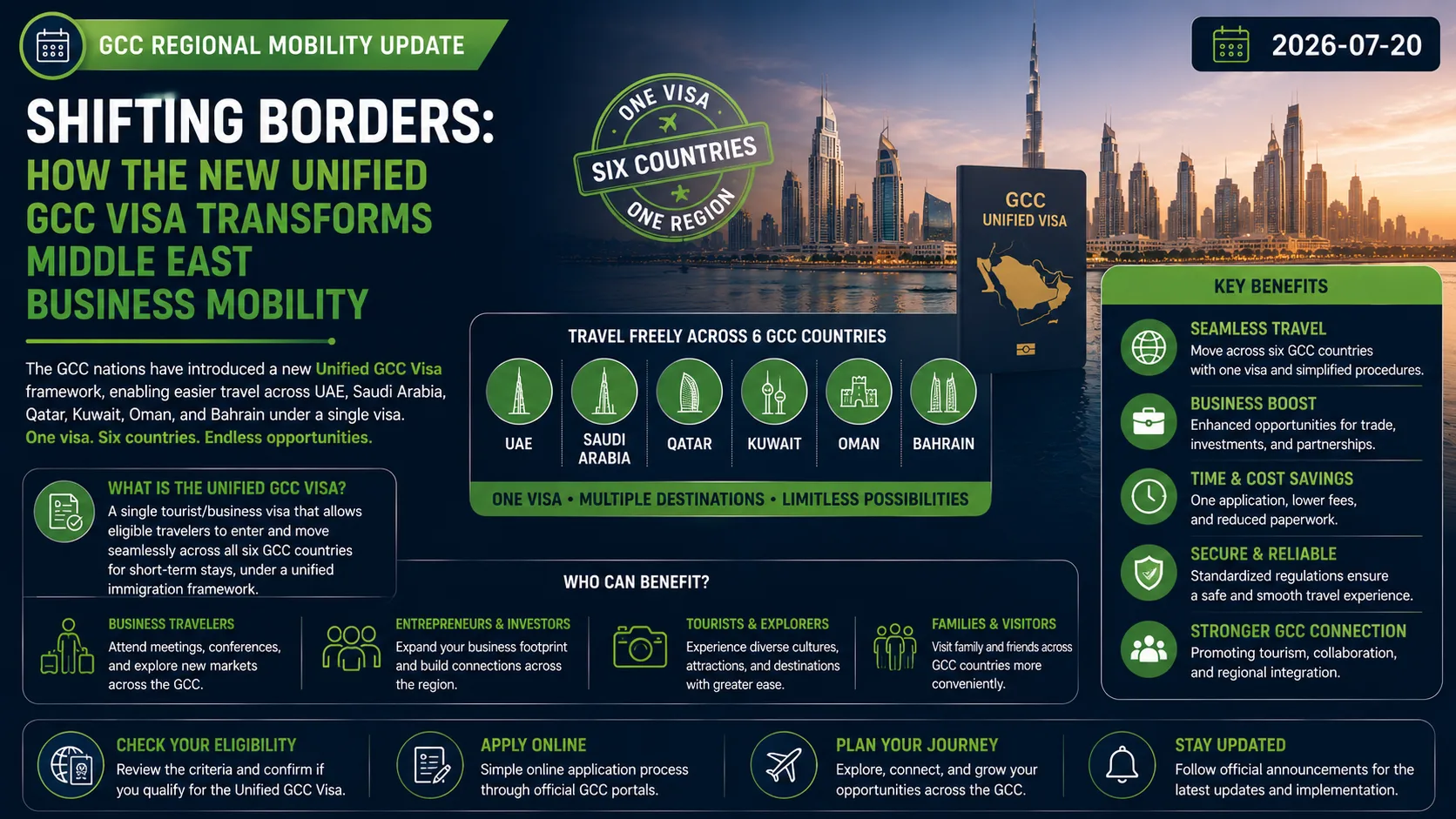
A single visa for travel across six Gulf countries would make regional holiday planning considerably simpler. That is the idea behind the proposed Unified GCC Tourist Visa, sometimes called the GCC Grand Tours Visa. The scheme has attracted attention from tourists, expatriates and business travellers, but its launch has taken longer than earlier announcements suggested.
For Indian travellers in particular, the difference between an approved proposal and a working visa system matters. Until the scheme is formally launched, entry to the UAE, Saudi Arabia, Qatar, Bahrain, Kuwait and Oman continues to depend on each country’s existing rules. A planned regional visa should not be treated as permission to cross borders today.
Quick answer: Is the Unified GCC Tourist Visa available in October 2026?
No operational launch or official unified application portal could be verified as of 13 October 2026. GCC leaders have reiterated plans for an integrated tourist visa, and the secretary-general said in September 2026 that it would launch soon, but did not announce a firm date, final fees or the application process. Travellers should continue to use the official entry rules of each destination. GCC Secretariat: https://gccsg.org/en/MediaCenter/News/Pages/news-2026-9-10-3.aspx
What is the proposed Unified GCC Tourist Visa?
The Unified GCC Tourist Visa is a regional tourism initiative designed to let eligible visitors travel between several Gulf Cooperation Council countries through a shared authorisation. The plan is frequently compared with Europe’s Schengen visa, but the exact rights, border procedures and conditions of the GCC arrangement will be determined by its eventual implementing rules.
The participating GCC countries are Bahrain, Kuwait, Oman, Qatar, Saudi Arabia and the United Arab Emirates. Each currently maintains its own immigration controls and national visitor-entry procedures.
In November 2023, GCC interior ministers approved the unified tourist visa initiative in principle. Subsequent public announcements have addressed technical coordination, border security and tourism integration. The September 2026 ministerial discussions continued to address implementation rather than announcing an operational visa. Official GCC statement: https://gccsg.org/en/MediaCenter/News/Pages/news-2026-9-10-3.aspx
Which six countries are expected to participate?
United Arab Emirates
The UAE is one of the six GCC members expected to participate. Until the common visa is launched, travellers should check UAE visa-free entry, visa-on-arrival or advance tourist visa eligibility based on their passport and circumstances. UAE government information: https://u.ae/en/information-and-services/visa-and-emirates-id/Visa-information/do-you-need-an-entry-permit-or-a-visa-to-enter-the-uae
Saudi Arabia
Saudi Arabia operates its own tourist and other entry categories. Eligibility may depend on nationality and qualifying foreign residence or visa status. Applicants should use the official Saudi visa channels before making arrangements. Official portal: https://visa.visitsaudi.com/
Qatar
Qatar provides visitor-entry options through the official Hayya platform and Ministry of Interior processes. Hayya eligibility varies by passport, GCC residence and qualifying third-country permissions. These national categories do not presently function as one visa for all GCC members. Official portal: https://hayya.qa/en
Oman
Oman’s visitor-entry arrangements include exemptions for certain travellers and Royal Oman Police eVisa options. The applicable category and documents should be confirmed for each traveller. Royal Oman Police eVisa portal: https://evisa.rop.gov.om/
Bahrain
Bahrain operates its own national eVisa and entry arrangements, with eligibility conditions depending on nationality and supporting documentation. Official eVisa portal: https://www.evisa.gov.bh/
Kuwait
Kuwait also maintains separate entry and visa rules. Travellers should confirm whether they qualify for any permitted electronic, visa-on-arrival or advance approval route through official Kuwaiti authorities. Ministry of Interior: https://www.moi.gov.kw/
Why has the unified visa taken longer to launch?
A shared visa requires more than a common online application form. Six governments must coordinate eligibility assessments, security screening, data exchange, identity checks, validity rules and arrangements for entry and exit.
GCC officials have described continued technical work and tourism-sector coordination. Publicly discussed launch targets have shifted, including earlier expectations around late 2025 and then 2026. These targets should not be mistaken for a legally effective start date.
The GCC Secretariat’s September 2026 statements emphasised closer cooperation among member states and continuing implementation of joint tourism initiatives. They did not announce a live unified visa. Official statement: https://gccsg.org/en/MediaCenter/News/Pages/news-2026-9-10-2.aspx
How could the Unified GCC Tourist Visa work after launch?
The policy objective is to simplify multi-country tourism through a common authorisation. Once final rules are issued, applicants may have a way to seek permission to visit participating countries without repeating separate national tourist-visa applications.
However, core details remain unconfirmed, including the exact application channel, eligibility by nationality, supporting documentation, whether entry will be single or multiple, and the authorised length of stay. Those should be treated as open questions until they appear in official rules.
Are the GCC visa fee and validity confirmed?
No official, universally applicable fee schedule or final validity conditions could be verified for the unified visa as of the review date. Various media articles have mentioned proposed prices and stay durations, but those numbers should not be presented to readers as published government fees.
Travellers should avoid paying agencies advertising an already available GCC Grand Tours Visa. Government application availability, fees and conditions must be confirmed through an official platform once the programme launches.
Can Indian passport holders apply?
Eligibility for Indian passport holders under a future common visa has not been confirmed through final official programme rules. Indian citizens currently need to examine the requirements of the individual GCC countries they intend to visit.
The outcome can differ depending on whether the traveller holds an Indian passport alone, has valid GCC residency, or also possesses a qualifying visa or residence permit for another country. For example, Qatar’s Hayya platform has categories that consider GCC residency or certain third-country permissions. That does not establish eligibility for a future unified visa.
What is the difference between tourism, business visits and employment?
This is particularly important for corporate travellers. A unified tourist visa is being developed to support visits and regional tourism. It should not be assumed to provide a right to take up salaried employment, establish residence or undertake every kind of business activity in all six countries.
A trade exhibition, client meeting, conference, long-term assignment and local employment contract can involve different immigration permissions. Travellers should check the rules for their specific activities with each destination’s authorities until a final common system defines its permitted purposes.
Will the unified visa remove border checks?
There is no verified basis for claiming that the scheme will abolish immigration controls between GCC countries. The project is often called Schengen-style because of its proposed multi-country travel convenience, but that comparison does not mean it reproduces every feature of Europe’s border arrangements.
Travellers should expect each country to retain the legal authority to apply its own border and admissibility rules unless official implementing instruments provide otherwise.
How should a six-country trip be planned now?
- List the GCC countries on the itinerary and the order of entry.
- Check the national entry rules for the passport and residence status of each traveller.
- Identify whether any destination permits visa-free entry or a qualifying visa-on-arrival arrangement.
- Apply through the existing government or authorised national visa service where advance approval is required.
- Check passport validity, onward travel, hotel or host information and any compulsory insurance.
- Build sufficient time into the itinerary for separate application processing and border checks.
- Recheck official government announcements before travel in case the unified visa formally launches.
What could the eventual programme mean for business travel?
Easier movement between Gulf destinations could benefit conferences, trade exhibitions, tourism-linked commercial visits and multi-city market exploration. A unified route could also help travellers combine Dubai, Doha, Muscat, Manama, Riyadh and Kuwait City in one itinerary, subject to the final conditions.
Those possible advantages should not be translated into claims that the scheme has already reduced business visa costs, eliminated permits or authorised regional employment. Operational benefits can only be assessed after the final rules and actual service are published.
Common mistakes to avoid
- Assuming the Unified GCC Tourist Visa is already open for applications.
- Relying on a speculative price, duration or launch date as an official rule.
- Believing a UAE visitor visa automatically permits entry to every GCC country.
- Confusing GCC residency with GCC citizenship or universal visa-free entry.
- Assuming a tourist visa authorises local employment or unrestricted commercial activity.
- Paying a non-official provider that guarantees a unified visa before the programme launches.
- Booking multiple-country travel without verifying each destination’s current national requirements.
Frequently asked questions
Has the GCC Grand Tours Visa launched in 2026?
As of 13 October 2026, no operational common visa service or official application portal could be verified. Government officials continue to discuss implementation.
Which countries will the unified visa cover?
The six proposed participants are Bahrain, Kuwait, Oman, Qatar, Saudi Arabia and the UAE.
Can I use one UAE tourist visa to visit the entire GCC?
No. A UAE tourist visa does not automatically grant entry to the five other GCC member states.
Will the unified visa allow work in Saudi Arabia or Qatar?
No employment entitlement has been established for the proposed tourist visa. Work and residence permission should be considered separately under each country’s applicable rules.
What is the official price of the unified GCC visa?
No final unified government fee could be verified at the review date. Avoid relying on speculative pricing reported by unofficial application services.
How Zevantaa Careers can help
Zevantaa Careers can assist travellers and businesses in understanding regional mobility requirements, organising documentation and identifying the official country-specific processes relevant to an itinerary, within its agreed service scope.
Until the unified visa is formally launched, applications and entry permissions remain subject to the competent national authorities. Zevantaa cannot guarantee visa issuance, regional access or future policy implementation.
Explore Zevantaa’s visa and global-mobility guidance: https://zevantaacareers.com/visas/
Official references and editorial information
GCC Secretariat — September 2026 tourism ministers’ joint statement: https://gccsg.org/en/MediaCenter/News/Pages/news-2026-9-10-3.aspx
GCC Secretariat — September 2026 tourism integration statement: https://gccsg.org/en/MediaCenter/News/Pages/news-2026-9-10-2.aspx
UAE government — Current visa eligibility: https://u.ae/en/information-and-services/visa-and-emirates-id/Visa-information/do-you-need-an-entry-permit-or-a-visa-to-enter-the-uae
Qatar Hayya — Visitor visa portal: https://hayya.qa/en
Royal Oman Police — eVisa portal: https://evisa.rop.gov.om/
Saudi Arabia — Tourist eVisa portal: https://visa.visitsaudi.com/
Bahrain — Official eVisa portal: https://www.evisa.gov.bh/
Editorial verification: Publicly available GCC and national government guidance reviewed 13 October 2026. The unified tourist visa has not been presented as an operational service. The information is general guidance; final eligibility and entry decisions belong to the responsible authorities.