Australia National Innovation Visa Guide 2026
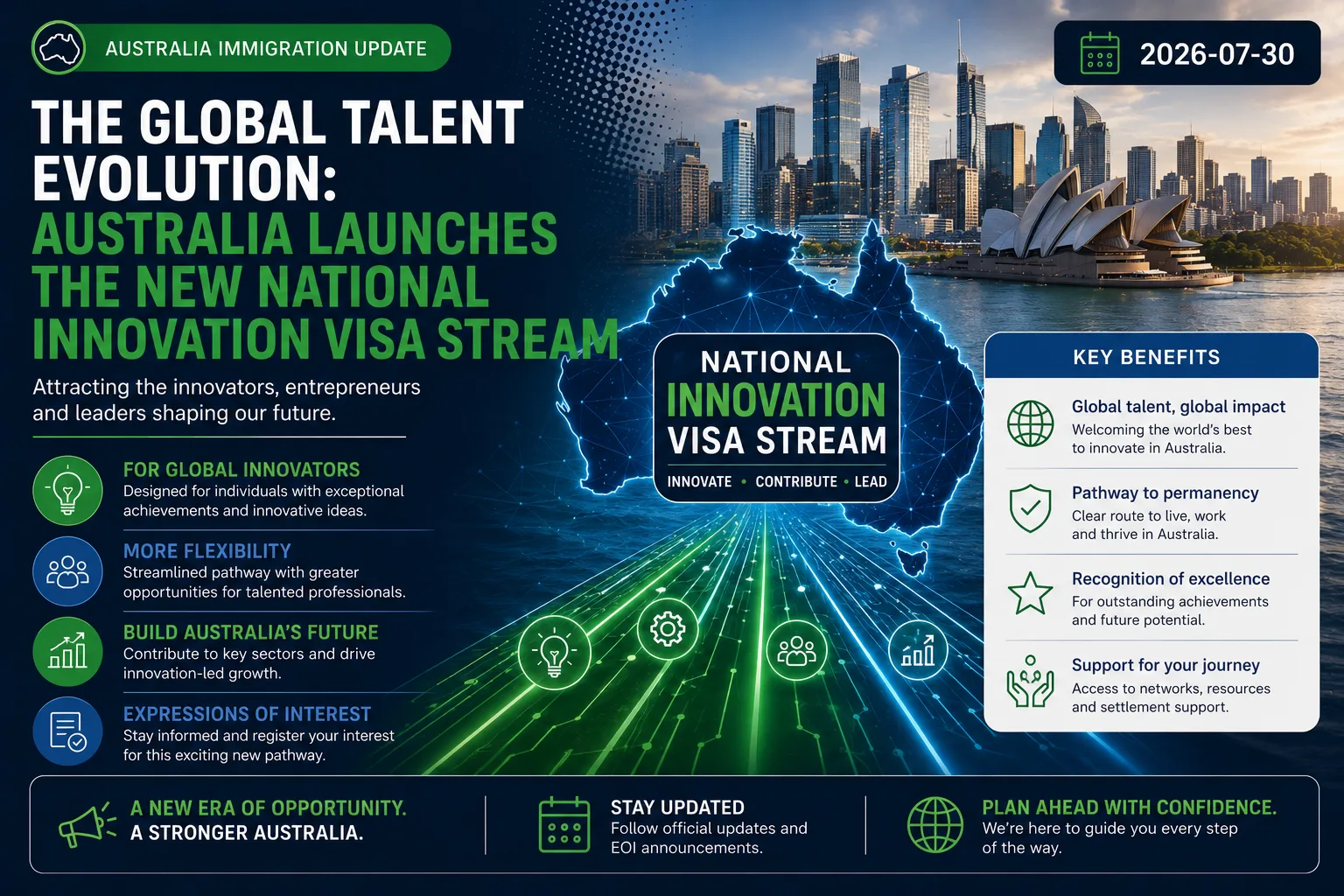
The Australian federal government has officially launched its premium National Innovation Visa framework, an elite immigration stream engineered to replace the old Subclass 858 Global Talent Visa. This high-end visa path is designed specifically to capture top-tier global innovators, venture-backed…
Quick answer: Can you apply directly for Australia’s National Innovation visa?
No. The National Innovation visa (subclass 858) is invitation-only. Applicants first submit an Expression of Interest, and an invitation does not guarantee visa approval. Official source: https://immi.homeaffairs.gov.au/visas/working-in-australia/visas-for-innovation/national-innovation-visa
Australia’s National Innovation visa is designed for people whose achievements stand out internationally. It is not a general skilled-worker route or an alternative for applicants who simply have extensive professional experience. The visa targets exceptional talent capable of contributing to Australia’s economy, research, culture and other areas of national importance.
The Australia National Innovation Visa (subclass 858) is a permanent visa, but applicants cannot lodge a visa application without first receiving an invitation from the Department of Home Affairs. Understanding the invitation process, evidence requirements and role of an Australian nominator is essential before preparing an Expression of Interest.
What is the National Innovation visa?
The National Innovation visa replaced the former Global Talent visa framework for new applicants in December 2024. It provides a permanent residence pathway for eligible people with an internationally recognised record of exceptional and outstanding achievement.
The programme is relevant to global researchers, entrepreneurs, innovative investors, athletes, artists and other exceptional professionals. However, a candidate’s occupation or business sector alone does not establish eligibility.
Official programme overview: https://immi.homeaffairs.gov.au/visas/working-in-australia/visas-for-innovation/national-innovation-visa
Who is eligible for subclass 858?
Applicants must demonstrate an internationally recognised record of exceptional and outstanding achievement in a profession, sport, the arts, or academia and research. The Department also expects applicants to remain prominent in their field and to show that their achievements are sustained rather than limited to a single routine career milestone.
The applicant must be able to contribute to Australia and establish themselves in their field. A qualifying nominator must attest to their achievements. Standard identity, health, character and other visa requirements also apply.
Applicants can be of any age, but those younger than 18 or aged 55 and over must demonstrate that they would be of exceptional benefit to the Australian community.
Which sectors receive priority in 2026?
The Department applies Ministerial Direction No. 120 when prioritising National Innovation visa invitations and applications. Priority is based on the strength and nature of the achievement, not merely membership of a particular industry.
Priority 1: internationally recognised top-of-field awards
The highest priority is for exceptional candidates from any sector who are global experts and recipients of international top-of-field awards. This is a demanding standard and should not be confused with ordinary company awards or routine professional recognition.
Priority 2: nominations by expert government agencies
The second priority covers candidates from any sector who have a qualifying Form 1000 nomination from an expert Australian Government, state or territory government agency. This is distinct from an ordinary private nominator.
Priority 3: exceptional achievement in Tier One sectors
Tier One sectors are critical technologies, renewables and low-emission technologies, and health industries. Examples include artificial intelligence, cybersecurity, advanced manufacturing, renewable energy, biotechnology and medical innovation.
Priority 4: exceptional achievement in Tier Two sectors
Tier Two sectors include agri-food and AgTech, defence capabilities and space, education, financial services and FinTech, infrastructure and transport, and resources.
The official priorities explain the relevant sectors and achievement indicators in greater detail: https://immi.homeaffairs.gov.au/visas/working-in-australia/visas-for-innovation/national-innovation-visa/priorities
What evidence demonstrates exceptional achievement?
The Department assesses the substance and international standing of an applicant’s work. Depending on the field, evidence might include major international awards, significant research grants, highly influential publications, patents, internationally recognised business achievements, senior academic appointments or major artistic and sporting distinctions.
For entrepreneurs, evidence of commercialising an innovation or building a successful venture may be relevant. For researchers, publication quality, citations, grants and influence in the field may help establish standing. No single item guarantees an invitation.
Evidence should show the applicant’s own contribution, not simply the success or reputation of an employer or organisation. Recent achievements matter because applicants must remain prominent in their field.
How does the Expression of Interest process work?
The first formal step is to submit an Expression of Interest (EOI) through the Department’s National Innovation visa process. The EOI describes the candidate’s achievements and includes supporting information for the Department to consider.
An EOI is not a visa application. Submitting one does not provide lawful immigration status, a bridging visa or an entitlement to an invitation. EOIs remain active for two years unless withdrawn or superseded under the Department’s procedures.
Applicants generally cannot add documents or edit a submitted EOI. A new EOI may be appropriate when there has been a significant change in circumstances or new achievements materially strengthen the candidate’s case.
Official EOI guidance: https://immi.homeaffairs.gov.au/visas/working-in-australia/visas-for-innovation/national-innovation-visa/eoi-submission
What happens after an invitation?
If the Department invites a candidate, the invitation includes a reference and code needed to apply. The candidate has 60 days from the invitation date to lodge the visa application. The Department states that this period cannot be extended.
An invitation does not mean eligibility has already been approved. The visa application is assessed on its merits and must substantiate the achievements claimed in the EOI.
Who can nominate an applicant?
A National Innovation visa applicant must provide a completed Form 1000 from a nominator with a national reputation in the same area of achievement. An eligible nominator can be an Australian citizen, Australian permanent resident, eligible New Zealand citizen or Australian organisation.
The nominator attests to the applicant’s exceptional record. They do not grant the visa, and nomination by a private organisation does not automatically place a candidate in the government-agency priority category.
Applicants should identify an appropriate nominator before an invitation arrives, because the completed Form 1000 must accompany the visa application within the 60-day period.
Is the National Innovation visa permanent?
Yes. Subclass 858 is a permanent visa. A successful applicant may live, work and study in Australia indefinitely, subject to the visa conditions and relevant laws. Permanent residence is not the same as citizenship, and international travel after the initial travel facility expires may require a Resident Return visa or other appropriate status.
Family members may be included where the visa rules permit. The applicable charges and requirements should be checked through the Department’s current visa listing.
Does a high salary or senior job title guarantee eligibility?
No. High earnings, an executive title or employment in a priority sector may be relevant evidence, but the visa requires an internationally recognised record of exceptional and outstanding achievement. A routine senior management career is not automatically sufficient.
The Department also assesses the ability to establish oneself in Australia in the relevant area of expertise. Applicants should not treat an EOI as a replacement for a properly documented record of achievement.
Common mistakes to avoid
- Assuming that working in artificial intelligence, healthcare or FinTech automatically qualifies a candidate.
- Confusing a private Form 1000 nomination with a government-agency priority nomination.
- Submitting broad claims of innovation without evidence of personal achievements and international recognition.
- Treating an EOI as a visa application or as permission to remain in Australia.
- Waiting until after invitation to begin identifying a suitable nominator.
- Missing the non-extendable 60-day application deadline.
- Assuming that an invitation guarantees permanent residence.
Frequently asked questions
Can Indian entrepreneurs apply for the National Innovation visa?
Yes, potentially. Nationality does not prevent an eligible Indian entrepreneur from being considered, but they must demonstrate the exceptional achievements and other requirements of subclass 858.
Is a job offer required?
A job offer is not a universal requirement. Applicants must instead demonstrate that they can establish themselves in Australia in their field, along with meeting the visa’s other conditions.
How long is an EOI valid?
The Department keeps a National Innovation visa EOI active for two years from submission, unless it is otherwise withdrawn or replaced under the relevant procedures.
Can I apply without an invitation?
No. The National Innovation visa is invitation-only, and an application must be lodged within 60 days of the invitation.
How Zevantaa Careers can support your planning
Zevantaa Careers helps professionals understand relevant Australian immigration pathways, review documentation readiness and identify questions that may need specialist attention before proceeding. For a National Innovation visa case, the key issue is whether the applicant has credible evidence of internationally recognised exceptional achievement.
Any immigration assistance involving regulated legal advice or visa representation must be provided by a person authorised under the applicable Australian rules. No consultancy can guarantee an invitation or visa approval.
Plan your next step
Before submitting an EOI, review the official achievement indicators, assemble evidence of your personal contribution and international standing, and consider whether a qualified nominator could substantiate the record. A carefully assessed case is more useful than a speculative submission based on a job title or industry trend.
Explore Zevantaa Careers’ Australia visa guidance: https://zevantaacareers.com/visas/australia-immigration/temporary/
Official references
Department of Home Affairs — National Innovation visa: https://immi.homeaffairs.gov.au/visas/working-in-australia/visas-for-innovation/national-innovation-visa
Department of Home Affairs — Subclass 858 visa requirements: https://immi.homeaffairs.gov.au/visas/getting-a-visa/visa-listing/national-innovation-visa-858
Department of Home Affairs — Invitation priorities: https://immi.homeaffairs.gov.au/visas/working-in-australia/visas-for-innovation/national-innovation-visa/priorities
Department of Home Affairs — After EOI submission: https://immi.homeaffairs.gov.au/visas/working-in-australia/visas-for-innovation/national-innovation-visa/after-submission