Australia Work and Holiday Visa 462 Guide 2026
The Australian Department of Home Affairs has introduced structural updates to the Working Holiday Maker (WHM) visa program to streamline seasonal labor flows and support bilateral mobility agreements with key international partners.
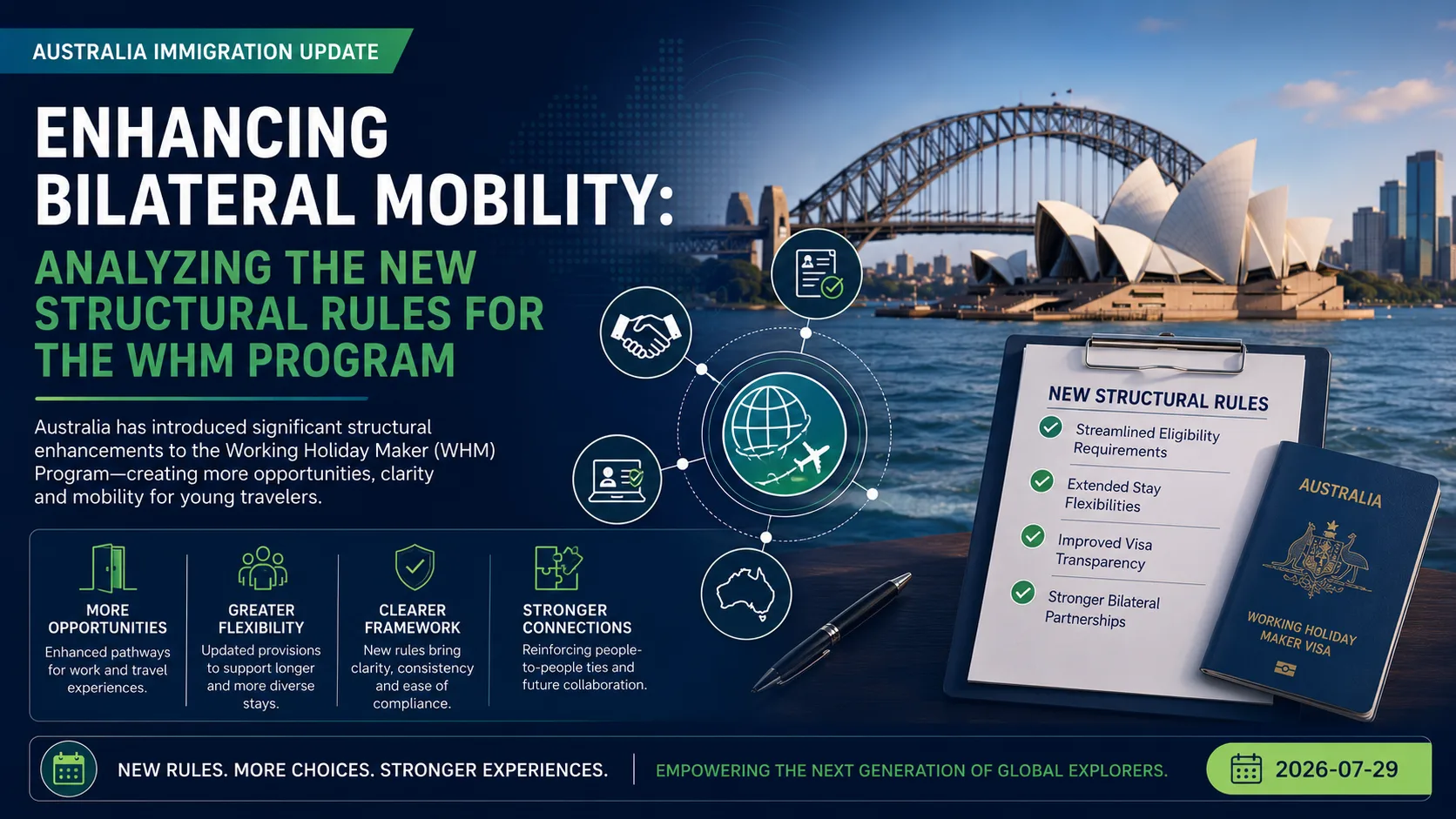
Australia’s Work and Holiday visa gives eligible young adults an opportunity to travel around the country while taking short-term employment to help pay for their stay. For Indian passport holders, the relevant visa is subclass 462. It is not an employer-sponsored skilled migration visa, and it does not automatically lead to permanent residence.
India joined the Working Holiday Maker programme in September 2024 under the Australia–India Economic Cooperation and Trade Agreement. Up to 1,000 first Work and Holiday visas may be granted to eligible Indian citizens in each programme year. Demand is managed through a ballot, so meeting the basic criteria does not mean someone can immediately lodge an application.
Quick answer: Can Indian citizens apply for Australia’s Work and Holiday visa?
Yes. Eligible Indian passport holders aged 18–30 can be considered for the first Work and Holiday visa (subclass 462). They must participate in the official pre-application ballot and be randomly selected before applying. Applicants must also satisfy education, functional English, funds, health and character requirements. Selection in the ballot is permission to apply, not visa approval.
Official source — Australian Department of Home Affairs: https://immi.homeaffairs.gov.au/visas/getting-a-visa/visa-listing/work-holiday-462/first-work-holiday-462
What does subclass 462 allow you to do?
A first Work and Holiday visa generally permits a stay of 12 months. Holders can travel in and out of Australia, work to support their holiday and study for up to four months. The visa is intended primarily for a holiday, rather than unrestricted long-term employment.
The visa carries conditions, including limits on the period spent working with one employer. Any permission to work longer than those limits must be considered under the relevant exemption or approval procedure. Applicants should check their actual grant conditions in VEVO.
Who qualifies for the first visa?
For Indian applicants, the core conditions include being a citizen of India with a valid Indian passport and being 18 to 30 years old when applying. The applicant must be outside Australia when making the first visa application and when the visa is granted. Dependent children cannot accompany the visa holder on this visa.
Applicants must have successfully completed at least two years of post-secondary study and demonstrate at least functional English. They also need sufficient funds for their stay and departure, and must satisfy the relevant health and character requirements. A previous entry on a subclass 417 or 462 visa can affect eligibility for a first visa.
The Australia–India agreement sets out the educational and language framework for eligible Indian citizens. The current visa checklist and acceptable documents are determined by the Department of Home Affairs: https://www.dfat.gov.au/trade/agreements/in-force/australia-india-ecta/australia-india-ecta-official-text/side-letters-work-and-holiday-visas-australia-india
How does the Indian subclass 462 ballot work?
India is one of the countries whose first Work and Holiday applications are managed through a pre-application ballot. An eligible person registers through ImmiAccount and, if randomly selected, receives a notification allowing them to submit a first visa application within the applicable window.
The registration process requires the relevant passport and national identity details, a verified email address and a declaration. The Department states a ballot registration charge of AUD 25. The visa application charge is separate and payable only if a selected applicant proceeds with a valid visa application.
The ballot is random rather than a ranking of grades, salary or work experience. No education agent or consultancy can guarantee selection, and paying an intermediary does not improve the odds.
Is the 2026–27 India ballot currently open?
Ballot registration dates and selection windows are controlled by the Australian Government and may differ between programme years. The Department’s programme updates reported a 2026–27 ballot registration window and subsequent random selections. Applicants should check the official ballot page for the current registration status, selection announcements and any future window rather than relying on a dated social media post.
Official ballot updates: https://immi.homeaffairs.gov.au/what-we-do/whm-program/latest-news/new-work-and-holiday-subclass-462-visa-pre-application-process
How many places are available for Indian applicants?
Under the bilateral arrangement, up to 1,000 first subclass 462 visas may be granted to eligible Indian citizens per programme year. This is a grant cap, not a promise that every ballot registrant will receive a place. Second and third Work and Holiday visas operate under different eligibility rules and are not counted in the same first-visa cap.
The Department publishes country-cap information, which can change as places are filled: https://immi.homeaffairs.gov.au/what-we-do/whm-program/status-of-country-caps
What does the visa cost in 2026?
As displayed by the Department’s first subclass 462 visa listing in October 2026, the first visa application charge is AUD 840. The ballot registration fee is AUD 25 and is separate from the visa charge. Fees may change and card or payment surcharges may apply; applicants should use the official visa pricing estimator before paying.
Other potential expenses include passport documentation, English evidence, health examinations if requested, travel insurance, flights and living costs. Do not treat the visa charge as the full cost of a working holiday.
Can you work for any employer?
Work and Holiday visa holders may undertake work in a range of occupations, but condition 8547 generally limits employment with any one employer to six months. Exemptions exist for certain work, including specified critical sectors and work across different locations. Where no exemption applies, written permission may be required to stay longer with the same employer.
Applicants should check the Department’s current exemptions rather than assuming that a professional office job or a particular job title automatically qualifies. Employment rights and protections under Australian law still apply to working holiday makers.
Official work limitation guidance: https://immi.homeaffairs.gov.au/what-we-do/whm-program/specified-work-conditions/6-month-work-limitation
Can Work and Holiday visa holders study in Australia?
Subclass 462 ordinarily permits study or training for up to four months. It is not a substitute for a student visa intended for a longer academic programme. The applicable work and study conditions should be checked in the visa grant letter or VEVO.
How can you qualify for a second Work and Holiday visa?
Eligible first subclass 462 holders may apply for a second Work and Holiday visa after completing at least three months of specified subclass 462 work in the locations and industries covered by the official rules. The Department interprets the three-month period as the equivalent of 88 calendar days, subject to how the work is counted.
The specified-work rules distinguish ordinary work from employment that qualifies towards a subsequent visa. Not every job or location counts. Applicants should retain payslips, employer details, dates and other evidence of the work.
Official specified-work rules: https://immi.homeaffairs.gov.au/what-we-do/whm-program/specified-work-conditions/specified-work-462
What about a third Work and Holiday visa?
A third subclass 462 visa may be available to eligible holders who have completed at least six months of qualifying specified work while holding the relevant second visa or eligible bridging arrangements. The Department defines the six-month minimum as the equivalent of 179 calendar days, assessed against the detailed counting rules.
A second or third visa is a separate application. It is not automatic and remains subject to age, passport, work-history and other applicable conditions.
Is the Work and Holiday visa a permanent residence pathway?
No. Subclass 462 is a temporary cultural and travel programme. Some holders may later become eligible for a different Australian visa, but any student, skilled, employer-sponsored or permanent visa would have its own independent requirements. Completing a working holiday does not secure a sponsorship or permanent residency outcome.
People seeking a long-term career in Australia should compare the Work and Holiday route with the appropriate skilled or employer-sponsored options instead of treating it as a guaranteed bridge.
Common mistakes Indian applicants should avoid
- Treating ballot registration as a valid visa application or a guarantee of selection.
- Paying an unverified intermediary who promises to secure a ballot place.
- Ignoring the age limit or applying for the first visa while in Australia.
- Assuming any short course satisfies the two-year post-secondary study requirement.
- Confusing the ballot fee with the separate visa application charge.
- Working beyond the six-month employer limit without confirming an exemption or written permission.
- Assuming any employment counts towards the second-visa specified-work requirement.
- Booking non-refundable travel before receiving a visa grant.
Frequently asked questions
Can an Indian aged 31 apply for the first subclass 462 visa?
The standard first-visa age limit is 18–30 inclusive when applying. A person must lodge the visa application before turning 31 under the applicable Australian time-zone rules.
Does the Australian Work and Holiday visa require a job offer?
A job offer is not a general eligibility requirement for the first Work and Holiday visa. Its primary purpose is travel with permission to undertake short-term work, subject to visa conditions.
Does a ballot invitation mean the visa is approved?
No. A selected registrant must still submit a valid application and satisfy the Department’s visa requirements.
Can Indian subclass 462 holders study?
Yes, for up to four months under the usual study restriction. Longer study generally requires consideration of another visa.
Can a subclass 462 holder work for the same employer for 12 months?
Not automatically. The usual maximum is six months with one employer unless an applicable exemption or authorised permission allows more.
How Zevantaa Careers can help
For Indian applicants, a useful first step is to confirm ballot eligibility, the correct education and English evidence, funds and the conditions attached to a temporary working holiday. Zevantaa Careers can assist with understanding the document-readiness process and comparing possible Australia visa routes within its agreed service scope.
No consultancy can guarantee ballot selection, work placement or visa approval. All visa decisions are made by the Australian authorities.
Explore Zevantaa’s Australia immigration guidance: https://zevantaacareers.com/visas/australia-immigration/
Official references and update notes
Department of Home Affairs — First Work and Holiday visa (subclass 462): https://immi.homeaffairs.gov.au/visas/getting-a-visa/visa-listing/work-holiday-462/first-work-holiday-462
Department of Home Affairs — Ballot process: https://immi.homeaffairs.gov.au/what-we-do/whm-program/latest-news/new-work-and-holiday-subclass-462-visa-pre-application-process
Department of Home Affairs — Specified work and subsequent visas: https://immi.homeaffairs.gov.au/what-we-do/whm-program/specified-work-conditions/specified-work-462
Department of Home Affairs — Employer work limitation: https://immi.homeaffairs.gov.au/what-we-do/whm-program/specified-work-conditions/6-month-work-limitation
Department of Foreign Affairs and Trade — Australia–India Work and Holiday arrangement: https://www.dfat.gov.au/trade/agreements/in-force/australia-india-ecta/australia-india-ecta-official-text/side-letters-work-and-holiday-visas-australia-india
Editorial review: Prepared using Australian Government sources checked on 13 October 2026. Visa eligibility, fees and ballot status are subject to change. The article provides general information and does not claim independent migration-law review.