Australia Visa Application Charges Guide 2026
Australia has revised its Visa Application Charges (VAC) across key immigration, work, and student visa categories. Learn how the updated fee structure affects applicants and why accurate payment is essential for a smooth visa application process.
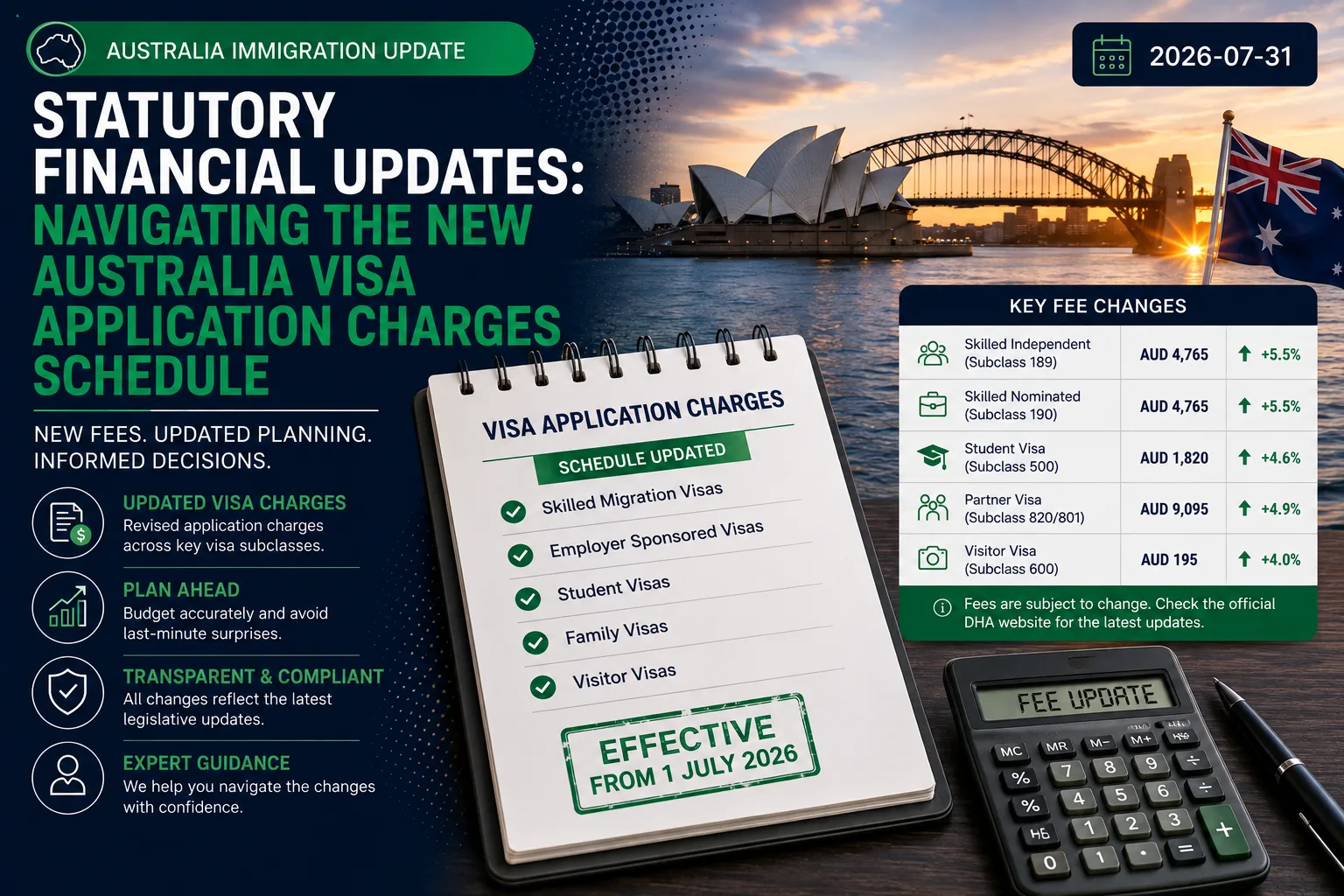
Australia’s visa application costs changed in 2026, but a single headline percentage does not explain what an applicant will actually pay. Student, skilled, graduate and visitor visas have different base charges, while family members, later instalments and eligibility-based concessions can change the total.
For an Indian applicant budgeting for Australia, the useful starting point is the visa subclass and the date the Department of Home Affairs receives the valid application. That determines which official fee schedule applies. Applicants should also separate government application charges from health examinations, document preparation and professional services.
Quick answer: How much are Australian visa application charges in October 2026?
Official Home Affairs pages currently show, for standard main-applicant routes, Student subclass 500 from AUD 2,500, Skilled Independent subclass 189 from AUD 6,135, Skilled Work Regional subclass 491 from AUD 6,140, Temporary Graduate subclass 485 first-stream routes from AUD 5,750 and Visitor subclass 600 tourist stream outside Australia from AUD 250. These are starting charges, not final quotes for every applicant or family. The official Visa Pricing Estimator should be used to confirm a particular case. Source: https://immi.homeaffairs.gov.au/visas/getting-a-visa/fees-and-charges
Australia visa fees 2026: quick comparison
The following figures are published starting prices on the cited Home Affairs visa pages at the editorial review date. All are in Australian dollars; concessions and circumstances can change actual amounts.
- Subclass 500 — Student visa: from AUD 2,500 for the standard main applicant. Official information: https://immi.homeaffairs.gov.au/visas/getting-a-visa/visa-listing/student-500
- Subclass 189 — Skilled Independent, points-tested: from AUD 6,135. Official information: https://immi.homeaffairs.gov.au/visas/getting-a-visa/visa-listing/skilled-independent-189
- Subclass 491 — Skilled Work Regional (Provisional): from AUD 6,140 for a main applicant. Official information: https://immi.homeaffairs.gov.au/visas/getting-a-visa/visa-listing/skilled-work-regional-provisional-491
- Subclass 485 — Temporary Graduate, Post-Higher Education Work and Post-Vocational Education Work routes: from AUD 5,750. Official information: https://immi.homeaffairs.gov.au/visas/getting-a-visa/visa-listing/temporary-graduate-485
- Subclass 485 — Second Post-Higher Education Work stream: from AUD 2,265, when the specific stream’s eligibility rules apply. Official information: https://immi.homeaffairs.gov.au/visas/getting-a-visa/visa-listing/temporary-graduate-485/second-post-higher-education-work
- Subclass 600 — Visitor visa, Tourist stream, applying outside Australia: from AUD 250. Official information: https://immi.homeaffairs.gov.au/visas/getting-a-visa/visa-listing/visitor-600/tourist-stream-overseas
Do not use the starting price from one stream for a different stream, an onshore application or a family application. This comparison does not cover every Australian visa, every concession or all subsequent charges.
What changed from 1 July 2026?
Home Affairs updated a number of visa application charges from 1 July 2026. Its student visa page confirms an increase and displays the current standard starting amount. Several skilled and visitor visa pages also explain cost concessions introduced for eligible Pacific Island and Timor-Leste passport holders, with certain student visa concessions extending to eligible ASEAN applicants or specific study sectors.
These concessions are based on defined official criteria; an Indian passport holder should not assume eligibility merely because they live in a neighbouring region or hold a visa for another country. For a historical fee comparison, use dated government schedules, not a mixture of figures taken from different years.
Important October 2026 update: payment surcharges
Home Affairs states that, effective 1 October 2026, it ceased applying surcharges on card, PayPal and UnionPay payments following the government’s updated direction. Older guides that still add an automatic card or PayPal visa-payment surcharge may therefore misstate current costs.
This concerns the Department’s specified payment surcharges; it does not mean bank foreign-exchange costs, conversion margins or third-party service charges have universally disappeared. Check the actual payment summary and your bank’s charges. Official surcharge update: https://immi.homeaffairs.gov.au/visas/getting-a-visa/fees-and-charges/explanation-of-visa-application-charges/surcharges
When does the new visa fee apply?
The Department explains that the relevant fee can depend on when it receives the application. If a charge rises between the applicant initiating or lodging a transaction and the Department receiving the application, the updated charge may be payable.
Applicants should use the current estimator on their intended submission date, have adequate funds available and retain a government payment receipt. Avoid planning around an older fee simply because preparation began before the change. Official explanation: https://immi.homeaffairs.gov.au/visas/getting-a-visa/fees-and-charges
How is a visa application charge calculated?
The Visa Application Charge (VAC) is not always a single figure. Home Affairs divides it into components, including a base application charge for the principal applicant and, for eligible combined applications, charges for accompanying applicants. Some cases have a second instalment, non-internet application charge or subsequent temporary application charge.
The exact combination depends on the subclass, stream, location and personal circumstances. A visa application with a nil base charge can be subject to different rules. Home Affairs provides its official calculation and charge explanations rather than a universal formula. Reference: https://immi.homeaffairs.gov.au/visas/getting-a-visa/fees-and-charges/explanation-of-visa-application-charges/calculating-the-visa-application-charge
Base applicant versus additional family members
A family that applies together may have one base charge and additional applicant charges for eligible partners and children. An applicant aged 18 or over can attract a different additional charge from a younger dependant. These amounts vary by visa.
Some visitor streams require separate applications for each family member. Never calculate a couple’s or family’s total by multiplying a single ‘from’ price without checking the correct subclass rules and application structure.
What is a second instalment charge?
Some visas can have a charge payable later in processing, separate from the first application payment. Certain skilled visa pathways describe second instalments related to adult family members who do not have functional English. Applicants are instructed to pay such amounts only if and when the Department requests them.
The amount and applicability must be verified on the particular visa page. The standard pricing estimator may not include every later instalment, making it important to plan for the full potential cost rather than only the amount shown at lodgement. Example official guidance: https://immi.homeaffairs.gov.au/visas/getting-a-visa/visa-listing/skilled-work-regional-provisional-491
Subclass 500: student visa fees and budget planning
The official Student visa page now displays a standard starting application charge of AUD 2,500. The Department also identifies a lower cost for certain eligible applicants, including specified Pacific Island and Timor-Leste citizens, relevant ASEAN applicants and defined English-language or non-award study categories.
A student should not confuse the government application charge with tuition, Overseas Student Health Cover, living-cost evidence, medical examinations or document costs. Eligibility and application rules can also change independently of the fee. Notably, Home Affairs identifies additional student visa rule changes taking effect on 2 October 2026. Official student visa page: https://immi.homeaffairs.gov.au/visas/getting-a-visa/visa-listing/student-500
Subclass 189 and 190: skilled permanent residency fees
The official Skilled Independent subclass 189 page displays a starting price of AUD 6,135 for the points-tested stream, with limited concessions. Its grant is not guaranteed by paying the charge: this visa also involves eligibility, invitation and other criteria.
Subclass 190 is a separate skilled nominated visa with its own pricing and state or territory nomination process. The current government estimator should be used for its precise application cost rather than automatically assuming it is identical to the subclass 189 price. Nomination-related charges, where applicable, may also be separate.
Subclass 189 official page: https://immi.homeaffairs.gov.au/visas/getting-a-visa/visa-listing/skilled-independent-189
Subclass 491: regional skilled visa fees
Home Affairs displays a starting charge of AUD 6,140 for the Skilled Work Regional subclass 491 main-applicant route. Additional family or second-instalment charges can apply as prescribed.
A regional nomination or eligible family sponsorship, skills assessment, English testing and other requirements are separate from the VAC. Applicants should avoid advertisements that present the base charge as the complete cost of qualifying for regional migration.
Official visa page: https://immi.homeaffairs.gov.au/visas/getting-a-visa/visa-listing/skilled-work-regional-provisional-491
Subclass 485: why the stream matters
Temporary Graduate subclass 485 has different streams, with different eligibility and prices. The official visa overview lists the Post-Vocational Education Work and Post-Higher Education Work starting prices at AUD 5,750. Its Second Post-Higher Education Work stream lists a lower starting amount of AUD 2,265 for those meeting the distinct regional second-visa conditions.
An applicant should first identify which stream is actually available. A reduced price on a later regional stream is not a general discount for anyone completing a degree in Australia.
Official subclass 485 overview: https://immi.homeaffairs.gov.au/visas/getting-a-visa/visa-listing/temporary-graduate-485
Subclass 600: visitor visa charges
The official Tourist stream for applicants outside Australia lists a starting charge of AUD 250. The Visitor subclass 600 has other streams and distinctions by application location, so the same price cannot be assumed for every visit.
A Visitor visa is not an ordinary work permit, and paying more does not purchase a longer stay or guaranteed approval. Select the proper stream and examine the conditions before committing to travel. Official tourist stream: https://immi.homeaffairs.gov.au/visas/getting-a-visa/visa-listing/visitor-600/tourist-stream-overseas
Costs outside the government visa application charge
A realistic budget should distinguish at least four categories: mandatory government visa charges; eligibility-related expenses such as language tests and skills assessments; document and health costs including police clearances or medical examinations; and optional professional or administrative assistance.
Currency conversion, banking costs, travel and supporting education or work expenses can also affect the full budget. No consultancy can legitimately present its own service charge as an official government fee.
Are Australia visa application charges refundable?
The Department’s refund guidance explains that a refusal or a change of mind does not normally entitle an applicant to receive the visa application charge back. Refunds are governed by particular legal and administrative grounds.
A person should therefore confirm the intended visa subclass and essential eligibility before paying. Never rely on verbal promises that a consultant will obtain an automatic government refund if the case is rejected. Official refund guidance: https://immi.homeaffairs.gov.au/change-in-situation/get-a-refund
How should Indian applicants plan for AUD exchange rates?
The government charges listed here are in Australian dollars, not Indian rupees. The INR amount can change with the exchange rate, bank conversion method and any third-party costs. A static INR conversion becomes outdated even if the AUD visa charge stays the same.
For financial planning, use an up-to-date rate from the actual payment provider and retain a buffer for exchange movements. Do not confuse a currency exchange spread with a fee imposed by Home Affairs.
Using the official Visa Pricing Estimator
- Choose the exact visa subclass and stream under consideration.
- Specify whether the application is made inside or outside Australia if the tool asks.
- Add eligible accompanying adults and children using their correct ages.
- Check nationality-based concessions or other relevant exemptions.
- Review the current government application amount and any later instalment described by the visa page.
- Budget separately for tests, medicals, police certificates, state nomination and optional support.
- Re-run the calculation immediately before submitting the application and check the final ImmiAccount payment summary.
Official current pricing and estimator entry point: https://immi.homeaffairs.gov.au/visas/getting-a-visa/fees-and-charges
Common mistakes when reading fee increase news
- Using a 2025 fee as though it remains the current 2026 application charge.
- Assuming every visa subclass increased by exactly the same percentage.
- Presenting the main-applicant starting price as the total for a whole family.
- Overlooking a later visa charge or a required independent skills assessment.
- Assuming all applicants qualify for regional or nationality-based concessions.
- Adding obsolete card or PayPal surcharges after the October 2026 policy change.
- Expecting automatic refunds after visa refusal or a decision not to travel.
- Treating payment of a visa fee as evidence that approval is guaranteed.
Frequently asked questions
How much is the Australia Student visa in 2026?
The Department currently lists subclass 500 from AUD 2,500 for the standard main-applicant route. Other charges and defined concessions may apply, so check the current estimator for the actual application.
What is the subclass 189 government fee?
Home Affairs lists the points-tested subclass 189 from AUD 6,135, subject to relevant details and concessions. This is the base starting cost and not a family-wide total.
Do Australian visa payments still have card surcharges?
Home Affairs says it ceased applying card, PayPal and UnionPay surcharges from 1 October 2026. Banks or other intermediaries can have separate currency or service costs.
Will a visa fee payment guarantee approval?
No. The charge pays for assessment and processing. Eligibility and application decisions are determined by the Department under Australian immigration law.
Can I receive a refund if my Australian visa is refused?
Generally not solely because of refusal. Refunds are available only where the relevant legal or administrative grounds apply.
How Zevantaa Careers can help with Australia visa planning
Zevantaa Careers provides global-mobility-related services. Applicants comparing Australian visa options can begin by clarifying the appropriate subclass, current official charge, documentation requirements and expected separate costs under the agreed service scope.
Australian visa charges and grant decisions are controlled by the Department of Home Affairs. Zevantaa does not determine government fees or guarantee outcomes, and any consultancy charges should be clearly distinguished from official application charges.
Explore Australia’s visa and migration information through Zevantaa: https://zevantaacareers.com/visas/australia/
Official sources and editorial notes
Australian Department of Home Affairs — Visa fees and charges: https://immi.homeaffairs.gov.au/visas/getting-a-visa/fees-and-charges
Home Affairs — Current visa pricing table: https://immi.homeaffairs.gov.au/visas/getting-a-visa/fees-and-charges/current-visa-pricing
Home Affairs — Payment surcharges (1 October 2026 change): https://immi.homeaffairs.gov.au/visas/getting-a-visa/fees-and-charges/explanation-of-visa-application-charges/surcharges
Home Affairs — Student visa subclass 500: https://immi.homeaffairs.gov.au/visas/getting-a-visa/visa-listing/student-500
Home Affairs — Skilled Independent subclass 189: https://immi.homeaffairs.gov.au/visas/getting-a-visa/visa-listing/skilled-independent-189
Home Affairs — Skilled Work Regional subclass 491: https://immi.homeaffairs.gov.au/visas/getting-a-visa/visa-listing/skilled-work-regional-provisional-491
Home Affairs — Temporary Graduate subclass 485: https://immi.homeaffairs.gov.au/visas/getting-a-visa/visa-listing/temporary-graduate-485
Home Affairs — Visitor subclass 600 overseas tourist stream: https://immi.homeaffairs.gov.au/visas/getting-a-visa/visa-listing/visitor-600/tourist-stream-overseas
Home Affairs — Refunds: https://immi.homeaffairs.gov.au/change-in-situation/get-a-refund
Editorial review: 13 October 2026. Prices quoted are starting amounts displayed by the Department at review, not guaranteed fixed costs or a full list of all visas. Some fee concessions and additional charges apply. Reconfirm official visa fees and payment policies before publication and immediately before application.