Germany Spouse and Family Reunion Visa Guide 2026
Moving to Germany for a skilled job can involve difficult family decisions. A professional may receive an employment offer and residence permit while their spouse or children remain in India. Germany's family reunification rules provide several pathways for eligible relatives…
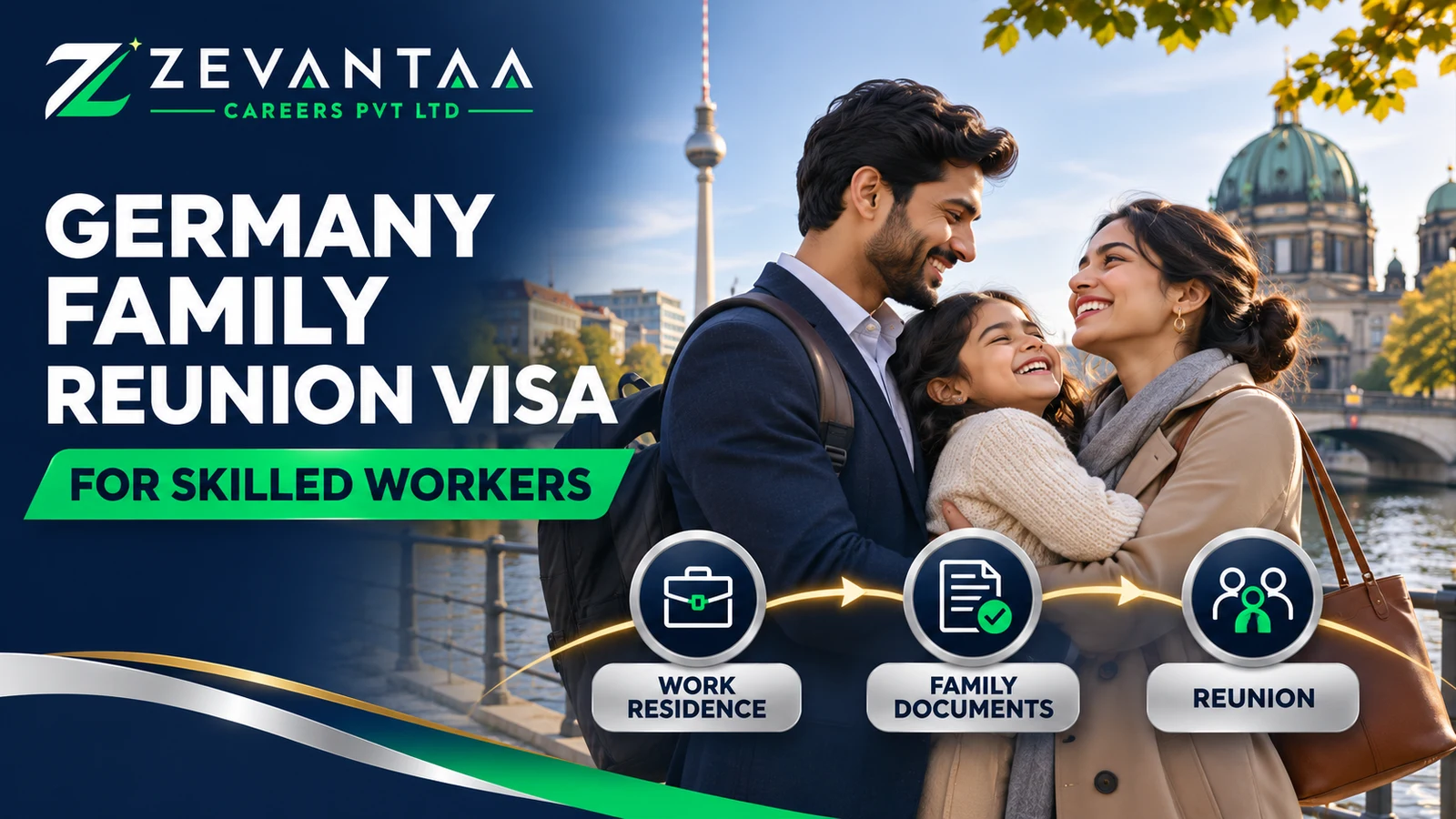
Moving to Germany for a skilled job can involve difficult family decisions. A professional may receive an employment offer and residence permit while their spouse or children remain in India. Germany’s family reunification rules provide several pathways for eligible relatives to live together, with facilitated conditions for some skilled-worker residence titles.
The crucial question is not simply whether the person in Germany has a job. Eligibility depends on the sponsor’s immigration category, the family relationship, age, insurance and financial circumstances. Language and accommodation rules can be more favourable for qualifying skilled workers, but the exceptions must be applied to the correct category.
Quick answer: Can a skilled worker bring their spouse and children to Germany?
Yes, potentially. A qualifying non-EU skilled worker holding an appropriate German residence permit, EU Blue Card or settlement permit can usually seek reunification for a spouse and eligible minor unmarried children. For specified skilled-worker residence titles, the joining spouse does not need to prove A1 German before arrival, and certain families no longer need to prove sufficient living space. Adequate health insurance and financial support can remain relevant. An individual family visa is decided by the competent German authorities. Official guidance: https://www.make-it-in-germany.com/en/visa-residence/family-reunification/spouses-joining-citizens-non-eu
What is a German family reunification visa?
A national family reunification visa allows an eligible non-EU family member to enter Germany for a longer stay to live with a qualifying spouse, parent or other family member. After arriving, the holder may need to register their address and obtain a corresponding residence permit from the local foreigners authority.
This is distinct from a short Schengen visit visa. A visit visa is for a temporary permitted stay; it should not be used as an assumed replacement for a family residence application. The correct route depends on the sponsor’s status and the applicant’s nationality.
Who can sponsor family reunification?
The conditions differ for German citizens, EU/EEA citizens, foreign skilled workers, EU Blue Card holders, students and other residence categories. This guide concentrates on Indian families joining a non-EU skilled worker who is lawfully resident in Germany.
A qualifying sponsor may hold a residence permit for skilled employment, EU Blue Card or settlement permit. Applicants must check the exact legal section of that title rather than assume every German visa has identical family benefits.
Do spouses need A1 German in 2026?
Not in all cases. The German government’s current family reunification guidance says that no proof of German language skills is required for family members joining skilled workers holding qualifying residence titles. It specifically identifies EU Blue Card, specified skilled-worker, research and several other residence categories among routes benefiting from the language exemption.
This is a category-specific exception, not the abolition of A1 for every marriage visa. A person joining a German citizen or a person holding another residence category can face a different test. The German Missions in India FAQs also distinguish the sponsor’s nationality and residence status. Sources: https://www.make-it-in-germany.com/en/living-in-germany/learn-german/knowledge and https://india.diplo.de/in-en/service/2546350-2546350
What does the A1 exemption mean in practice?
An eligible spouse should identify the sponsor’s actual residence title and submit the evidence requested by the German mission. If the relevant rules provide an exemption, an A1 certificate should not be described as a universal precondition merely because an older generic checklist mentions language evidence.
Learning German still has practical value for employment, school communications and daily life. The absence of a pre-entry language certificate is not a promise that language will never be relevant to later immigration or settlement arrangements.
What financial proof is required?
The official skilled-worker spouse guidance requires appropriate health insurance and sufficient means for family maintenance, subject to particular legal exceptions. The evidence can depend on the sponsor’s employment, income, family size, insurance and status.
The national rules do not establish one universal monthly salary that guarantees a spouse and children will receive visas. Applicants should check the foreigner’s authority and mission checklist and prepare genuine earnings and insurance evidence when relevant.
Do skilled workers need a bigger apartment?
Germany’s Skilled Immigration Act facilitated family reunification for spouses and minor children joining certain skilled workers by removing the requirement to prove sufficient living space. This exception is tied to specified qualifying residence titles and should not be generalised to every sponsor.
Practical accommodation still matters for registration and family welfare. Where the exemption applies, it is misleading to promise that an arbitrary minimum floor area remains a universal immigration threshold for the eligible category. Official reform explanation: https://www.make-it-in-germany.com/en/visa-residence/skilled-immigration-act
Can an EU Blue Card holder bring their spouse?
An EU Blue Card holder may qualify for facilitated spousal reunification, including an exemption from the usual A1 proof requirement under the relevant rules. Applicants need to provide the recognised relationship evidence, passports and other documents listed for their specific case.
The family route should be assessed against the Blue Card holder’s immigration status and circumstances, not simply against an employer’s statement that the person earns a high salary.
Can family apply together with the skilled worker?
Yes, German Missions in India explain that the spouse and minor children of a qualifying skilled worker may request family reunion visas when the skilled worker submits their own employment visa application. Appointment categories and sequencing can vary by location and residence type.
For some EU Blue Card, ICT or scientist-linked cases, the Indian mission provides a particular dependent category for family members applying at the same time or shortly after relocation. Using the wrong booking category can delay an application; check the responsible mission’s current instructions. Source: https://india.diplo.de/in-en/service/2546328-2546328
Family reunion for unmarried minor children
Germany’s official guidance provides for eligible unmarried children under 18 to join qualifying parents. The rules consider the child’s age, parents’ residence and custody. Where the child is aged 16 or 17, additional conditions may apply depending on the parents’ circumstances and the applicable law.
A child aged 18 or older generally needs an independent immigration pathway, rather than automatic inclusion in the minor-child reunion process. Official children guidance: https://www.make-it-in-germany.com/en/visa-residence/family-reunification/children-join
What if only one parent is moving with a child?
Where another person shares parental custody, the German government indicates that consent of the other parent entitled to custody may be required. Specific evidence can include custody orders, parental consent or other legally valid documents relevant to the case.
Applicants should not alter parental declarations or assume a birth certificate alone resolves every custody question. The mission’s current checklist and the laws governing parental responsibility determine what is needed.
What if a child is already 16?
Germany warns that certain applications involving children aged 16 or above can have additional conditions, especially where a child is arriving separately and the parents’ circumstances do not fall within an exemption. Eligibility therefore cannot be decided simply by saying the child is under 18.
Families with teenagers should establish the exact relevant provision and apply in adequate time. Confirm the current guidance from the responsible embassy or foreigners authority before making irreversible relocation plans.
Can registered partners qualify?
Some registered civil partners qualify under the spouse reunification rules where the partnership has a legally recognised registration and substantially equivalent legal effects. Merely living together as an unmarried couple, without meeting the recognised status requirements, does not automatically establish the same eligibility.
Check the accepted civil partnership evidence and definitions for the specific circumstances. Official family guidance: https://www.make-it-in-germany.com/en/visa-residence/family-reunification/spouses-joining-citizens-non-eu
Can parents of skilled workers join them?
Germany expanded parental reunification under the Skilled Immigration Act for certain workers who first received an eligible residence title for employment on or after 1 March 2024. Under specified conditions, parents—and sometimes parents-in-law where the spouse is also permanently resident—may qualify.
This is not a general right for every German temporary resident to sponsor parents. The first issuance date, immigration category, relationship and means of support require individual review. The specific parental pathway may have substantial financial or insurance implications. Official reform summary: https://www.make-it-in-germany.com/en/visa-residence/skilled-immigration-act
Family visit visa versus parental reunification
Parents who want to visit temporarily should not automatically apply through a long-term parental reunion route. Short visits can fall under separate Schengen rules, while qualifying parental residence applications involve different requirements.
A family should clarify intended duration and purpose before selecting a category. The visitor route does not guarantee subsequent long-term residence or permission to work.
Can the spouse work in Germany?
German official guidance says a spouse granted the appropriate family residence permit is entitled to work in Germany without the usual limitation to a particular employer. The actual residence document and its conditions should be checked before starting work.
Employment in regulated professions may still require recognition or an occupational licence. A family reunification residence permit does not grant every professional credential automatically. Official source: https://www.make-it-in-germany.com/en/visa-residence/family-reunification/spouses-joining-citizens-non-eu
What documents should Indian applicants prepare?
Common evidence can include passports, civil or marriage certificates, children’s birth certificates, details of the sponsor’s German residence title, family relationship documents, and insurance, employment or housing evidence where required. The German mission may request additional translations, attestations, or custody documentation depending on the case.
These are common categories, not a substitute for the exact mission checklist. Applicants should use the German Missions in India national-visa portal for the correct visa category and jurisdiction, rather than rely on a downloaded old list. Official portal: https://india.diplo.de/in-en/service/2755482-2755482
Should marriage certificates be translated?
The German mission may require certified translations, apostilles or other formal evidence depending on the origin and form of a document. Do not assume that every Indian document needs the same authentication process or that a privately created translation will be accepted.
Before paying an agent for attestation services, check the latest checklist from the specific German mission or the Consular Services Portal for your place of residence.
Applying from India: step by step
- Confirm the sponsor’s exact German residence category and eligibility to reunite with family.
- Identify whether the applicant is a spouse, recognised registered partner, unmarried minor child or qualifying parent.
- Check any relevant A1 exemption, child age or custody rule and financial or health insurance conditions.
- Gather genuine family civil records, passports and the sponsor’s residence and employment evidence.
- Choose the proper national-visa category and German mission for the applicant’s residential jurisdiction in India.
- Follow the current official online or appointment procedure and submit required documents and biometrics.
- Respond to requests for clarification from the visa mission or foreigners authority.
- Once authorised to enter, register the address in Germany and complete the residence permit steps before the visa expires.
German Consular Services Portal: https://digital.diplo.de/
What happens after arriving in Germany?
Official guidance instructs families to register their residential address with the local registration office and, as applicable, apply for the family residence permit through the local foreigners authority before visa expiry. The actual steps can vary by municipality.
Keep identity documents, family certificates, insurance and sponsor’s income or accommodation evidence available for the residence procedure where requested. A long-term visa does not mean that future address registration and residence formalities can be ignored.
How long does family reunion processing take?
There is no reliable universal processing period for all spouse and child applications from India. Processing depends on the visa mission, file completeness, need for document verification, and coordination with German authorities.
Avoid claims that an intermediary can guarantee a decision within a fixed number of days. Check current appointment availability directly and avoid booking irreversible travel until the necessary permission is confirmed.
What does family reunification cost?
A realistic budget separates government visa and residence permit charges from translations, insurance, travel, document verification and optional professional help. Fees or exemptions can depend on applicant age, nationality, visa category and circumstances.
Use the mission’s current fee information instead of a generic cost estimate. A visa agency’s service fee must not be misrepresented as the German government’s fee.
Is family reunion the same as German permanent residency?
No. Family reunification normally establishes a lawful basis for a family member’s residence, but permanent settlement has separate requirements. Germany’s official settlement permit guidance describes a special route for qualifying spouses of skilled-worker settlement permit holders, involving residence duration, work, German language and other conditions.
For example, that specific route includes at least three years holding a residence permit, at least 20 hours a week of employment, B1 German, sufficient social and legal knowledge and living together, subject to all statutory conditions. These criteria are not automatic permanent residence on arrival. Source: https://www.make-it-in-germany.com/en/visa-residence/living-permanently/settlement-permit
How does this differ from the Opportunity Card?
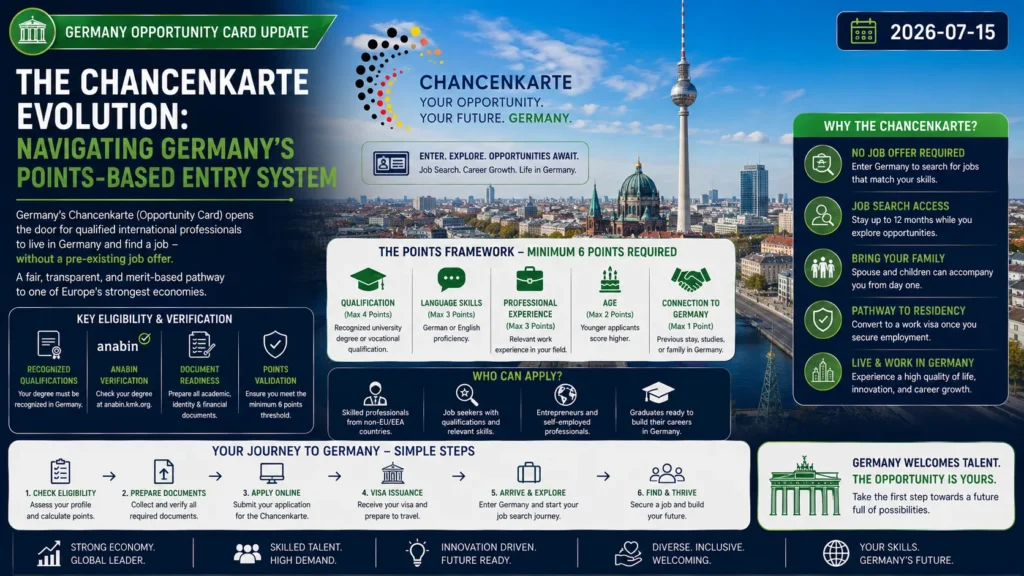
The Opportunity Card is a job-search title with its own restrictions and conditions. Family reunification as described here depends on a qualifying sponsor’s residence status and relationship. A person holding an initial job-search Opportunity Card should not automatically assume the same family benefits as a skilled worker with an employment residence permit.
If the sponsor changes residence title after finding employment, reassess the family route using the newly issued permission. Do not apply skilled-worker spouse exceptions to an unrelated residence category without confirmation.
Common Germany family visa mistakes
- Assuming every spouse joining Germany must always submit A1 language proof.
- Assuming no spouse anywhere needs A1 merely because skilled-worker exemptions exist.
- Treating all residence permits as having the same family rules.
- Claiming that all sponsors must show a fixed minimum apartment area even when an exemption applies.
- Ignoring insurance and lawful family maintenance requirements.
- Assuming a child aged 16 or 17 has exactly the same conditions as a younger child in all situations.
- Using the wrong visa category or responsible German mission in India.
- Treating a family residence permit as immediate permanent residency or unlimited professional licensing.
Frequently asked questions
Is A1 German mandatory for Indian spouses of skilled workers?
Not for qualifying residence titles covered by the skilled-worker exemption. A1 may still apply to other family visa categories, so verify the sponsor’s exact title and German mission checklist.
Can EU Blue Card holders bring spouses and children?
Potentially, yes. Eligible family members can apply under the relevant reunification rules, with facilitated conditions for certain categories. Individual eligibility and evidence requirements still apply.
Do skilled workers need to prove minimum apartment size?
For specified skilled-worker family reunification situations, the law removed the obligation to prove sufficient living space. Other categories may have different conditions.
Can a spouse work after joining Germany?
The appropriate family residence permit generally allows employment. The person should verify the actual permit and comply with separate registration or licensing obligations for regulated professions.
Can parents join a skilled worker in Germany?
Certain qualifying workers who first received their relevant work residence permit on or after 1 March 2024 may be eligible for parental reunification, subject to additional conditions. It is not available to every German resident.
Does family reunification guarantee permanent settlement?
No. Settlement permits and citizenship require their own statutory conditions and applications.
How Zevantaa Careers can help families plan
Zevantaa Careers provides Germany-related global mobility information. Families preparing for reunification can start with a review of the sponsor’s visa category, the correct application route, civil-document readiness and the current official requirements, within any separately agreed service scope.
The competent German mission and foreigners authority determine visa and residence outcomes. Zevantaa cannot guarantee approval, a processing date, unrestricted professional practice or permanent settlement.
Explore Zevantaa’s Germany visa information: https://zevantaacareers.com/visas/germany/
Official references and editorial notes
Make it in Germany — spouse of non-EU skilled worker: https://www.make-it-in-germany.com/en/visa-residence/family-reunification/spouses-joining-citizens-non-eu
Make it in Germany — reunification for children: https://www.make-it-in-germany.com/en/visa-residence/family-reunification/children-join
German Skilled Immigration Act — family facilitation: https://www.make-it-in-germany.com/en/visa-residence/skilled-immigration-act
German language exceptions for spouses: https://www.make-it-in-germany.com/en/living-in-germany/learn-german/knowledge
German Missions India — national visas: https://india.diplo.de/in-en/service/2755482-2755482
German Missions India — family reunion FAQs: https://india.diplo.de/in-en/service/2546350-2546350
German Missions India — national visa FAQs: https://india.diplo.de/in-en/service/2546328-2546328
German government — settlement permit: https://www.make-it-in-germany.com/en/visa-residence/living-permanently/settlement-permit
Federal Foreign Office — digital consular portal: https://digital.diplo.de/
Editorial review: Official German federal and Indian mission sources checked 13 October 2026. All skilled-worker exemptions are conditional on the specific residence category. Financial, insurance, relationship and document conditions must be checked individually. This is general information, not a legal determination for a particular family.