
Australia SkillSelect EOI Application Guide 2026
Australia's SkillSelect system is where many skilled migration journeys move from preparation to consideration for a visa invitation. Applicants describe their occupation, qualifications, English ability and work experience in an Expression of Interest (EOI), which the Department of Home Affairs…
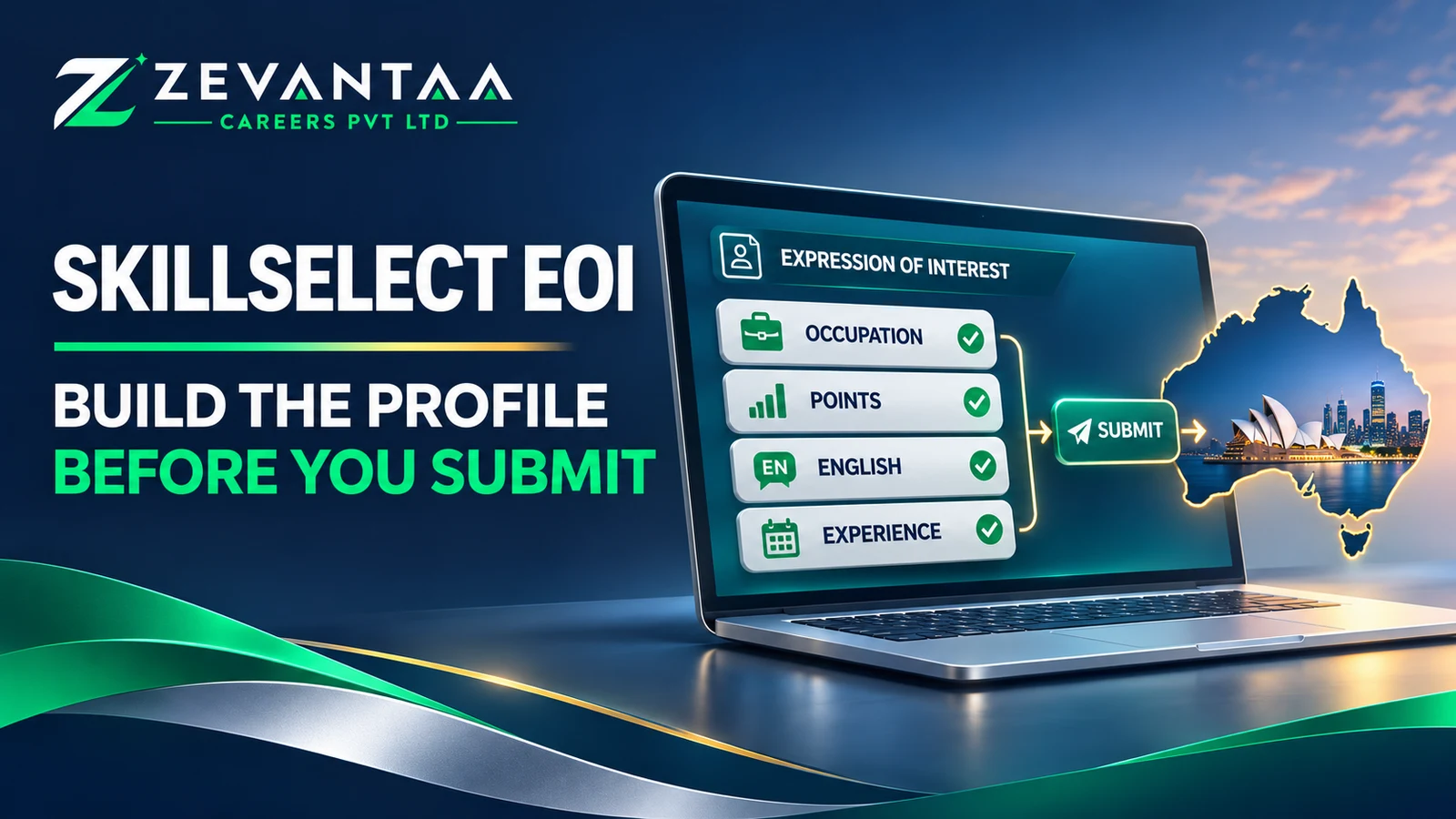
Australia’s SkillSelect system is where many skilled migration journeys move from preparation to consideration for a visa invitation. Applicants describe their occupation, qualifications, English ability and work experience in an Expression of Interest (EOI), which the Department of Home Affairs or an eligible state or territory authority may use when selecting candidates.
An EOI is not a visa application. It does not automatically create work rights, grant permanent residency or secure a place in an invitation round. Understanding that distinction can help applicants plan their evidence and avoid paying for the wrong step.
Quick answer: How do you submit a SkillSelect EOI?
Check that your occupation and intended visa route are eligible, review your indicative points and prepare accurate information about skills assessment, English results, education and employment. Create a SkillSelect EOI, complete all required fields and submit it. There is no need to upload supporting documents when first lodging an EOI, but you must be able to prove your claims if invited. An EOI stays active for two years and can be updated before invitation. Official instructions: https://immi.homeaffairs.gov.au/visas/working-in-australia/skillselect/expression-of-interest
What is SkillSelect?
SkillSelect is the Australian Government’s online system for people interested in particular skilled visas. It lets a potential migrant provide information relevant to eligibility and selection. Eligible applications proceed to a separate Home Affairs visa stage only when the required invitation has been issued.
The main points-tested visa categories using the system are the Skilled Independent visa (subclass 189), Skilled Nominated visa (subclass 190) and Skilled Work Regional (Provisional) visa (subclass 491). Each has different nomination, regional or family-sponsorship arrangements.
Official overview: https://immi.homeaffairs.gov.au/visas/working-in-australia/skillselect
Which visa should you express interest in?
Subclass 189 — Skilled Independent
The points-tested subclass 189 route does not depend on state nomination. Home Affairs issues invitations through its federal SkillSelect rounds based on the relevant selection settings, including points, occupations and tie-break rules. It is a permanent skilled visa, but neither the EOI nor an invitation establishes an automatic right to permanent residence.
Subclass 190 — Skilled Nominated
Subclass 190 requires a nomination by an Australian state or territory and is a permanent visa if granted. State governments apply their own occupation priorities, eligibility criteria and nomination processes. Selecting states in an EOI does not guarantee that one will nominate you.
Subclass 491 — Skilled Work Regional
Subclass 491 is a provisional regional visa, with routes involving state or territory nomination or eligible family sponsorship. The invitation process differs by route: state-nominated candidates are considered under government nomination procedures, while eligible family-sponsored candidates may receive invitations in Home Affairs rounds.
Federal visa and invitation overview: https://immi.homeaffairs.gov.au/visas/working-in-australia/skillselect/invitation-rounds
What should you do before creating an EOI?
Start with the actual nominated occupation and its presence on the applicable skilled occupation list. A job title is not always enough to establish the right code. Next, identify the suitable assessing authority and review whether a skills assessment is required for the intended visa pathway.
Review English-language evidence, qualifications, documented work periods, the possible role of a partner and any nomination criteria. The points calculator offers an indicative total, but claims ultimately need to satisfy visa rules.
Skills assessment guidance: https://immi.homeaffairs.gov.au/visas/working-in-australia/skills-assessment
How many points are needed for an Australian EOI?
Home Affairs states that the threshold for subclasses 189, 190 and 491 is 65 points. This is a minimum eligibility threshold, not a universal invitation cutoff. A candidate with 65 points can remain uninvited if the relevant occupation or nomination route requires stronger competition or different criteria.
The system draws on age, English ability, skilled employment and education, among other eligible factors. Use the official calculator and avoid copying someone else’s claimed points without confirming your own evidence.
Official points calculator: https://immi.homeaffairs.gov.au/help-support/tools/points-calculator
Does state nomination add points?
Under the points-tested system, eligible state or territory nomination for subclass 190 is associated with five nomination points, while qualifying subclass 491 nomination or family sponsorship is associated with fifteen points. These additional points depend on meeting the relevant statutory conditions and are not granted merely by indicating interest in a state.
A person should calculate points in the context of the chosen subclass and only claim circumstances that actually qualify. Check the live points test and state programme rules before preparing an EOI.
Step-by-step: creating a SkillSelect Expression of Interest
1. Start a new EOI
Open the official SkillSelect service and enter the requested identity and contact details. The system supplies an EOI identifier and login details. Keep access information secure; do not share the account password with an unverified agent.
2. Select eligible visa types
Identify the subclass or subclasses for which you intend to be considered. Be mindful that subclass 491 state nomination and family sponsorship follow different selection arrangements.
3. Choose the occupation
Use the relevant skilled occupation classification and ensure the description matches the actual work performed. The occupation also determines the recognised assessing authority and can affect eligibility across visa lists.
4. Enter English and skills assessment information
Record the relevant test and skills assessment details accurately as required by SkillSelect. Home Affairs allows users to save an EOI while information is being gathered and update it as evidence is obtained. The timing and sufficiency of a skills assessment for an actual visa application must still be verified independently.
5. Document qualifications and experience
Use real course dates, awarded qualifications, employers, job duties and employment periods. Distinguish relevant skilled experience from unrelated work and follow the rules for when points can be claimed.
6. Add partner and family information
Enter family information truthfully where requested. A change in partner status, children or a partner’s relevant skills can affect the circumstances declared and sometimes the points calculation.
7. Review the indicative score and submit
Check every detail before submitting. SkillSelect calculates an indicative score based on the information provided; it is not a formal approval of your evidence. Confirm contact details and monitor the email associated with the EOI.
Official EOI instructions: https://immi.homeaffairs.gov.au/visas/working-in-australia/skillselect/expression-of-interest
Do you have to upload documents to lodge an EOI?
No. Home Affairs says applicants do not upload supporting documents as part of the initial EOI. That does not remove the obligation to supply reliable information or substantiate it later. You will typically need evidence for the actual visa application after an invitation.
Keep originals and authorised copies of relevant identity, English, qualification, assessment and employment records ready. An EOI that overstates work experience can create problems when the later documents do not support the claimed score.
How long does an EOI remain active?
An EOI remains active for two years from submission. Home Affairs archives even incomplete EOIs after that period. There is no automatic guarantee of invitation during those two years.
If an EOI remains inactive or becomes outdated, review the current rules and consider whether a new valid EOI is appropriate once permitted, rather than assuming an old application remains in selection indefinitely.
Official post-submission guidance: https://immi.homeaffairs.gov.au/visas/working-in-australia/skillselect/expression-of-interest/after-you-submit-your-expression-of-interest
Can you update your EOI after submitting it?
Yes, before receiving an invitation. Home Affairs specifically identifies changes to work experience, education, English-language results, skills assessment or family structure as reasons to update an EOI. Updates may change the indicative points score and selection position.
After an invitation has been issued, SkillSelect says the EOI cannot be updated. Correctness before invitation is therefore important. Do not delay fixing an error merely because you think it will not affect your ranking.
What is the date of effect in SkillSelect?
For federal subclass 189 and family-sponsored subclass 491 invitation rounds, applicants with higher points are generally ranked ahead of those with lower scores. For candidates on equal points, Home Affairs uses the time and date at which the EOI reached that score for the visa subclass, known as the date of effect, as a tie-break.
This is not always the original EOI creation date. Improving your score or changing details can affect the relevant date of effect. Candidates should not treat an older EOI as inherently stronger than a later EOI with a higher score. Official selection details: https://immi.homeaffairs.gov.au/visas/working-in-australia/skillselect/invitation-rounds
Are subclass 190 invitations issued in the same federal rounds?
No. The Department’s main invitation rounds cover subclass 189 and the family-sponsored subclass 491 route. States and territories manage nomination selections for subclass 190 and state-nominated subclass 491 using their own priorities and available allocations.
A federal invitation-round announcement is therefore not a promise that every state nomination programme will issue invitations on the same date. Each state may also have its own registration-of-interest procedure, nominated occupation list or nomination application stage.
What is the next subclass 189 invitation round?
As of 13 October 2026, the current Home Affairs invitation-round page states that the next Skilled Independent subclass 189 round is scheduled for 15 October 2026. The site’s general overview has also been seen with a less specific ‘by 31 October 2026’ notice, so applicants should prefer the latest dated invitation-round notice and recheck it before publication.
A scheduled date is not a guaranteed invitation for a particular occupation. The number invited and the lowest relevant scores are known only after the Department publishes the results. Current government notice: https://immi.homeaffairs.gov.au/visas/working-in-australia/skillselect/invitation-rounds
How do occupation ceilings and invitation scores work?
Home Affairs may apply occupation ceilings to limit invitations from a particular occupational group in federal invitation rounds. Its invitation guidance says such ceilings do not apply to the state-nominated subclasses 190 or 491 in the same way.
Published minimum scores show what happened in a specific round for occupations actually invited. They are not guaranteed cutoff scores for the next round, and an occupation absent from a table may have had no eligible EOIs invited under that round’s settings.
What happens after receiving an invitation?
An invited applicant has 60 days from the invitation date to complete and lodge the visa application through ImmiAccount. The applicant must provide evidence supporting their claims and satisfy the full subclass conditions, including relevant health and character requirements.
An invitation is not the same as approval, and the 60-day deadline should not be treated as an optional planning window. Check the notification and current Home Affairs instructions, and get qualified assistance if a claimed fact is inaccurate or a crucial document is missing.
Can you decline or ignore an invitation?
An applicant who receives an invitation but does not lodge a visa application may remain subject to SkillSelect’s specific rules. Home Affairs says that if a person receives two invitations and does not apply for a visa, their EOI will be removed from the system.
There is no guarantee of a second invitation. Applicants should therefore consider readiness to pay the charge and provide documents before submitting or updating their EOI.
Is there a fee to submit SkillSelect EOI?
Creating and submitting an EOI in SkillSelect is not the same as paying the visa application charge. The government describes submission as an online expression of interest; visa charges arise at the later formal application stage, subject to the current pricing rules.
Additional expenses may include English testing, migration skills assessments, professional document preparation and optional consultancy support. Confirm each cost from the responsible provider rather than accepting a single unexplained ‘EOI government fee’.
Common EOI mistakes to avoid
- Treating the 65-point threshold as a guaranteed invitation score.
- Submitting an occupation that does not correspond to actual duties.
- Claiming English, work experience, qualifications or partner points without defensible evidence.
- Confusing the federal 189 invitation rounds with state nomination for subclass 190 or 491.
- Failing to update changes in work, English, skills assessment or family details before invitation.
- Assuming an EOI stays active forever or can still be edited after invitation.
- Treating a historical occupation cutoff or scheduled round as proof that you will be selected.
- Missing the 60-day visa application deadline after invitation.
Frequently asked questions
Can Indian applicants submit an Australia SkillSelect EOI?
Potentially. Eligibility is based on the selected occupation, visa subclass, skills assessment, English ability, points and other relevant requirements, rather than Indian nationality alone.
Is an EOI a visa application?
No. An EOI records interest and relevant claims in SkillSelect. A visa application can follow only after the appropriate invitation and compliance with application requirements.
How long can I wait for an invitation?
SkillSelect says an EOI is active for two years. There is no assured invitation within that period, and candidates cannot rely on a fixed waiting time.
Can I edit my EOI after an invitation?
No. Home Affairs says an EOI can be updated before invitation, not after one has been issued. The application itself must accurately address the invitation and required evidence.
Does state nomination automatically mean permanent residence?
No. Subclass 190 is a permanent visa if granted, while subclass 491 is provisional. In either case, a state nomination does not substitute for a federal visa decision.
How Zevantaa Careers can assist
Zevantaa Careers offers information and support relating to Australian global mobility pathways. Applicants can organise their occupation, skills assessment, documented points and subclass questions before preparing an EOI, within any separately agreed service scope.
Only the competent state and Australian Government authorities determine nomination and visa outcomes. No consultancy can guarantee a SkillSelect invitation, cutoff score or visa grant.
Explore Zevantaa’s Australia visa guidance: https://zevantaacareers.com/visas/australia/
Official sources and editorial notes
Home Affairs — SkillSelect overview: https://immi.homeaffairs.gov.au/visas/working-in-australia/skillselect
Home Affairs — EOI preparation and submission: https://immi.homeaffairs.gov.au/visas/working-in-australia/skillselect/expression-of-interest
Home Affairs — EOI validity, updates and two-invitation rule: https://immi.homeaffairs.gov.au/visas/working-in-australia/skillselect/expression-of-interest/after-you-submit-your-expression-of-interest
Home Affairs — Invitation rounds, tie-break and state selection: https://immi.homeaffairs.gov.au/visas/working-in-australia/skillselect/invitation-rounds
Home Affairs — Official points calculator: https://immi.homeaffairs.gov.au/help-support/tools/points-calculator
Home Affairs — Skills assessment: https://immi.homeaffairs.gov.au/visas/working-in-australia/skills-assessment
Editorial review: 13 October 2026. The 15 October 2026 invitation-round notice is time-sensitive and must be checked before publication. EOI requirements and state selection policies can change. Historical scores are not predictions. This article is general information and not a personal migration-law determination.